Tag Archives: PWD

More Education = Better Care!

I am happy to do dementia trainings for various sectors, but I am always honored to be asked to train staff at nursing homes and memory care communities.

I am honored because the employees I work with are generally CNAs or resident aides, and I would argue that how well they do their jobs is one of the most important factors–if not the most important factor–in quality of care.

Has it ever occurred to you in nursing homes and assisted livings that the people who are paid the least have the most direct contact with the residents?

I am continually amazed at the varying levels of dementia knowledge of employees.

I am surprised by how much people know. I am surprised how little people know.

And level of knowledge, anecdotally, doesn’t seem to be related to experience in the field.

In the state where I live, employees who work with those living with dementia have to do an online module to learn about dementia and meet the state requirement. And that’s it.

If you or a loved one are considering care, a great question to ask is, “What type of ongoing dementia education does your staff receive?

Research shows that facilities that invest in more dementia education for staff provide better care to residents. That’s not surprising, is it?

Dementia education….works.

Training programs for staff have been shown to improve staff-resident interactions, increase staff empathy for residents, and create more meaningful engagement with those living with dementia.

Dementia education increases staff knowledge, improves attitudes toward people with dementia, and boosts confidence of those providing care. They not only benefit residents but also positively impact staff by increasing job satisfaction and reducing burnout. 

If you want to look at the research studies, let me know, but the evidence is overwhelming.

Dementia education is linked to improved dementia care.

There is research about what types of education and delivery methods are most effective. When I plan a training, I go back to this research in designing something to meet the needs of the facility. I don’t deliver a cookie cutter training.

Not surprisingly, standard online modules (aka cookie cutter trainings) are not recommended as the best form of dementia education. However, I understand that facilities are challenged by staff turnover. I can’t come to your facility every week to train new employees. I get it.

Facilities are doing the best they can with the challenges and limitations that exist in the industry. Long term care is incredibly complicated.

Dietary staff, CNAs, resident aides, maintenance, and everyone else….You are doing a hard job and we need to give you the tools to succeed. And I want you to enjoy the important work that you do!

A friend of mine recently went with her father to explore an assisted living that serves those living with dementia. Her father is in the early stages of Alzheimer’s and wants to put a plan in place. (Can I just say–good for him!)

The assisted living was beautiful. A grand lobby. An enviable coffee bar for the residents. The resident rooms were spacious.

My friend, at my suggestion, asked what type of ongoing dementia education is required for staff.

She was told that they do an online module within 30 days of their start, and then yearly they must complete more online training. That’s in compliance with the state law.

My friend asked if they had opportunities for ongoing education. The response was that there was a lot of stuff out there on Tik-Tok now that shows how to “treat dementia people.”

After more conversations with other employees from the community, she was not convinced that providing excellent dementia care was a priority.

She heard some of the employees using non-dementia friendly language in chatting with her.

“Dementia person”

“Dementia sufferer”

“Senile”

People who work in facilities like this should be educated on dementia friendly language.

Despite the beauty of the building, they decided it wasn’t a fit.

While it is frustrating that some nursing home employees have a low level of knowledge about dementia, that lack of knowledge isn’t their fault. People know what we teach them. Let’s teach them.

Here’s the thing about work trainings. They can be dry and boring. I promise that I am not dry and boring. I may be weird and loud but not dry and boring.

I want employees to leave MORE excited about working with residents. I want to teach them to find the joy in their jobs and celebrate the wins. I want them to gain confidence and know that their employers in investing in them.

It’s not just about what I do, of course. There are other qualified individuals who do dementia education. (Make sure you check their qualifications and education!)

Turnover among nursing home employees in challenging for communities. If we can get people to enjoy working with those living with dementia, turnover decreases, the facility saves money, and staff provides better care.

To communities that make continuing education a priority…you deserve recognition. People should know that you are taking steps to invest in and educate your employees. Please talk about this when you market your community. It’s important.

Your commitment to education and, consequently, providing better care is admirable.
The Who, When, and How: Telling People You Have Dementia

Sometimes I have to check myself.

Sometimes I attempt to make things simpler than they are.

Once in a while, I am asked by someone if they should share their diagnosis of Alzheimer’s or another dementia with family, friends, co-workers, or community.

Example: A while back I chatted with a couple. The husband had been diagnosed with Alzheimer’s. They were uncertain about who they should tell. In the six months since diagnosis, they had told no one–not even their kids or closest friends.

They asked me if they should tell people.

I said yes.

I didn’t say, “Shout it from the rooftops,” but I might as well have.

When I spoke with them again recently, I asked who they had told. They looked at each other and seemed to not want to admit to me that they hadn’t told anyone.

My first thought was to tell them it was time. So I did.

It was time to tell others so others that others could support them.

But then I stopped. I realized that I sounded like I was disappointed in them. Like they were kids who had not done their homework.

I had to back up and think about all the reasons why it’s hard for people to disclose a diagnosis of Alzheimer’s or another dementia.

When I told them to tell people, I was ignoring a host of contextual factors.

So why don’t people disclose their diagnosis?

  1. Some people are just private people. And once the news gets out there, it’s out there. You can’t take it back.
  2. Individuals living with dementia may fear that disclosing their diagnosis will lead to others questioning their independence or capabilities.
  3. Each person copes with a dementia diagnosis differently. For some, keeping the diagnosis private allows them to process their feelings without external pressures or judgments. It may take some people longer to open up about the diagnosis.
  4. In some cultures or families, discussing health issues may be seen as inappropriate.
  5. A dementia diagnosis can feel like a loss of control over one’s life. Keeping the diagnosis private allows individuals to maintain some level of control over their situation.
  6. Maintaining a sense of normalcy in daily life can be crucial for individuals with dementia. They may want to continue engaging in social activities, work, or hobbies without other people reminding them that they have dementia.
  7. Many people fear that disclosing a dementia diagnosis could alter the dynamics of their relationships. They might worry that friends and family will treat them differently—either with excessive concern or a lack of confidence in their abilities.
  8. Individuals may choose to keep their diagnosis private out of a desire to protect their loved ones from emotional distress.
  9. Let’s face it. There is still a stigma that comes along with dementia. It’s a medical condition–yet many associate it with incompetence and lack of intellect.

And, for all of those reasons and others, I have to understand that I cannot tell people what they should do.

I want to encourage people to let others know when they need support. You can’t expect support when people are in the dark.

And yet, I cannot dictate the who and the when and the how.

Also, in my perfect world, when you tell others you have dementia, you get support. I know that’s not always true. Sometimes you tell people and they let you down.

I did happen to ask that couple why they had not told anyone about his dementia. Their daughter was getting married in a few months. They wanted to wait until after the wedding.

I wanted to tell them they should tell people before wedding in case they needed a little extra support during that time….. but I didn’t.

Because I don’t get to tell them what they should do.

Just Say No to Comparison

It’s the holidays, and my gift to you is that you will hear from me frequently. Just kidding.

Well, not kidding about hearing from me frequently, but kidding about it being a gift. Hopefully you have higher expectations for gifts this year.

But I am here. And I wish I could do more for those of you who read my blog regularly. I appreciate you, and you deserve the best possible holiday season. Maybe you don’t know how to make that happen. Maybe you are flying by the seat of your pants. But I am here and I am rooting you on.

Because the holidays and dementia. It’s a lot.

The holidays are hard. They can be joyful, peaceful, fulfilling, as well. They can be more than one thing.

They can be sad and rewarding. They can be difficult and joyous. They can be depressive and happy. They can be any combination of anything.

It’s not an either/or.

You get to feel whatever you feel, and it may be all over the place if you live with dementia or are a care partner. Or if you’ve lost someone recently. Or even not so recently. Or if you’re divorced or struggling with chronic illness. Or if you are struggling financially. Or if you are going through IVF.

It seems like many of us have complex situations that put us on the holiday struggle bus.

And we watch Hallmark movies (well, I don’t because the plot is the same every time and I am the least romantic person on earth) and have these expectations that our holidays will end on a happy note with a bow wrapping it all up. And then those sappy commercials with those happy harmonious families celebrating together…

Comparison is the thief of joy.

I didn’t make that up. I just Googled it, and it sounds like the quote is attributed to Teddy Roosevelt.

If you prefer, “Comparison is the death of joy” is attributed to Mark Twain. I will go with the Mark Twain version because I lived in towns on the Mississippi for the first 18-ish years of my life.

When we talk about comparison in this context, we think of the comparison between ourselves and others. The comparison between our holidays and the holidays of our neighbors. Our meager light display and the full-blown light show down the street with that giant blow-up reindeer.

Your family has been impacted by dementia. You might look at families you know and even families on TV and in the movies. Your family is different than those families. You will celebrate the holidays in a different way than other families.

When we try to mimic other families, we are often disappointed. We are not them. Even at times when we don’t want to be us, we are still us.

Sometimes the comparison that kills your joy is your comparison of past and present. The holiday season now versus the holiday season 5 years before Mom’s diagnosis. New Year’s Eve last year when Dad was around to celebrate versus now when you watch the ball drop without him.

Sigh.

Your family is not only different from other families but different from how it used to be.

It’s an obvious statement. But think about it for a sec.

Maybe the rituals you’ve always found important, like midnight mass or the all day holiday gathering with the grandkids, don’t work anymore. When you are different, you need to change.

Don’t put square pegs in round holes.

Even if your peg used to be round.

I didn’t make up the first part (although I can’t find who I should credit) but maybe I made up the second part.

Have the best possible day.

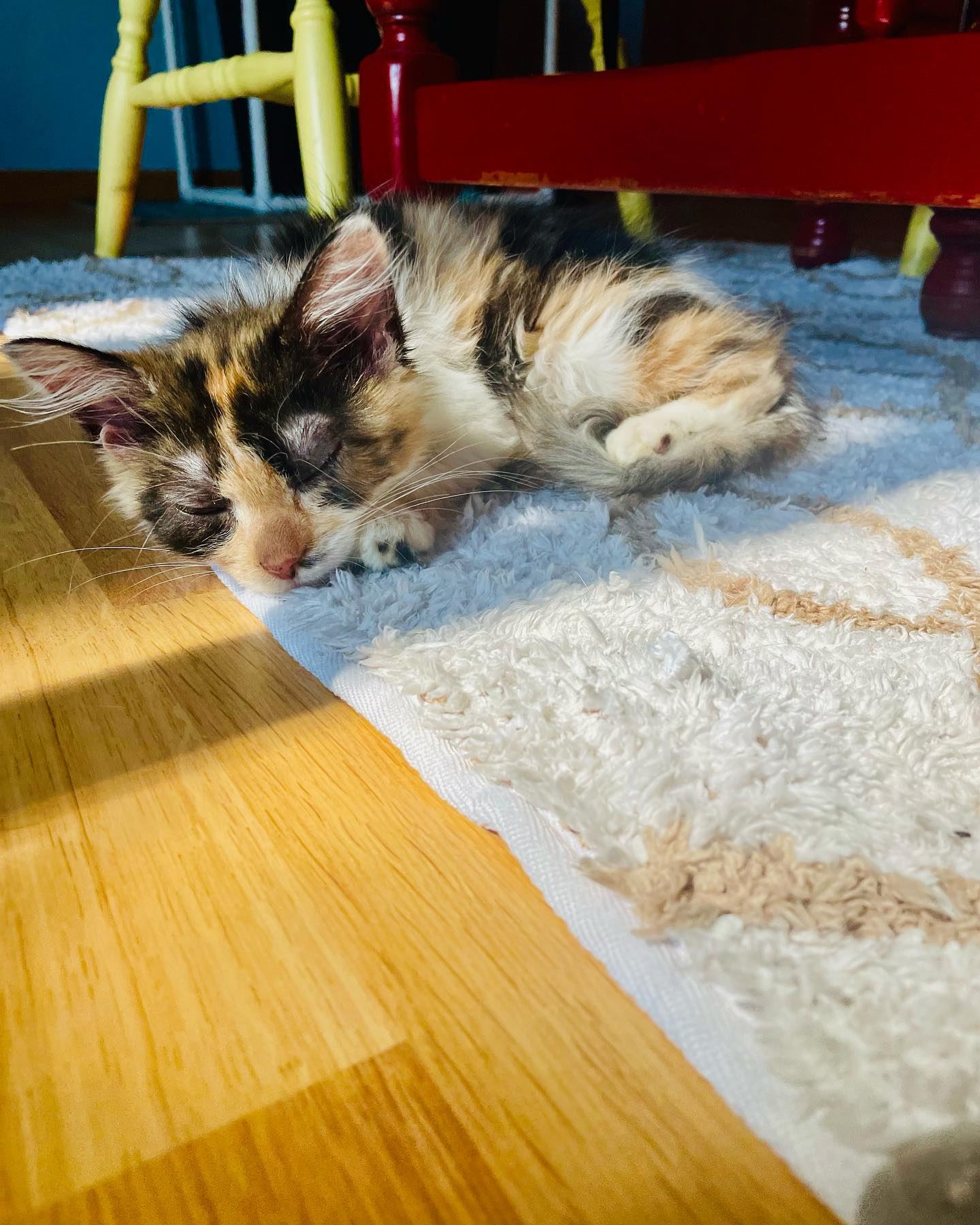
If it helps, here is a picture of our kitten, Gladys.

I am pulling out all the stops here, folks.

Calico kitten

My Holiday Letter to You

Dear Friends,

Happy holidays!

Here’s little update on our fam. Bill is an administrator at the University of Northern Iowa. I am a professor of Gerontology. Gus-Gus, our resident geriatric dog, is now 17 and wears a belly band. His eyes are cloudy but he’s thriving. Carlos, our youngest pup, is now about 6. His hobbies include trying to eat cat food and borrowing under blankets. Our three cats continue to be furry terrorists who do things like knock everything off the mantle and attempt to seize control of the counter.

Sounds like we will be getting a new puppers in the next week or so. We will be adopting from an animal rescue that takes in disabled and geriatric dogs. You want pics? Oh, you’ll get pics.

But about my holidays wishes for you….

I really don’t care what you celebrate. Hannukah? Christmas? Winter Solstice? National Pumpkin Pie Day? National Consumer Rights Day? Any/all of the above? My message here is the same.

Have the best possible holidays.

Not the most perfect holidays ever. Not the most exciting holidays ever. Not the most awe-inspiring holidays ever.

Just the best possible holidays.

You don’t have to have four different kinds of pie. Each person doesn’t need a dozen presents to open. It’s fine if you don’t get around to putting up a tree. You can do minimal decorations. You can buy pre-made stuff for dinner. You don’t need to organize post-meal games and entertainment.

Let it go.

Seriously. Let it go.

Many of us love the holidays. Some of us don’t. And, really, quite a few of us probably both love and hate the holidays all at once.

If your family is impacted by dementia this year (or if you’ve lost someone recently), the holidays might not look the same.

And that’s okay.

I read something the other day that stuck with me.

Everything ends, and that’s okay.

It reminded me of the times in my life where I’ve held onto something too long. A romantic relationship. A friendship. A job. A hobby. Even a pair of jeans that doesn’t fit anymore (because I am going to lose the weight, right?).

It takes a lot of energy to hold onto a tradition when everything around that tradition is changing.

The yearly family tour of holiday lights. The gingerbread house building contest. The all-day holiday movie marathon. Midnight mass. Early morning worship service. The 6am present opening start time.

Maybe it worked before. Maybe it doesn’t work anymore.

Everything ends, and that’s okay.

Someone with dementia may not have the stamina for an all day holiday celebration. It’s okay if they only stay for 45 minutes. It’s fine if they go take a nap in the bedroom. If they have little patience with loud and excited children, allow them a quiet space to regroup. Or get the heck out of there.

The holidays are different now. It’s okay.

I know from experience that you can get take out for Christmas dinner. The local grocery store cooks it and all you need to do is re-heat it. Maybe you are going to miss mom’s sweet potato pie, but you will survive. And clean-up is easier, too.

You know what happens if don’t have the time or energy to go out and buy holiday gifts? You can shop online. If that’s too much, you can give cash or gift cards. And, you know, if you aren’t in a position to be able to give gifts, people understand. And if they don’t understand, they’re jerks and that’s their problem.

The holidays can be pretty dang joyous, but they’re a lot. They’re a lot for people living with dementia. They’re a lot for care partners.

Small gatherings might be better than big gatherings. Short intervals with kids may be better than long intervals with kids. Quieter may be better than louder. Less lights might be better than more lights.

And, as is my advice year-round, always have an exit plan. Maybe it’s a hotel. Maybe it’s a quiet room at a gathering. Maybe it’s a conversation before an event where you explain that you’ll quietly slip out when the time is right–even if it’s only 20 minutes into the gathering.

Oh, and don’t feel the need to explain all of your decisions to family members who don’t even try to understand your reality. They don’t have to get it. In fact, they probably won’t.

As for me, this is goodbye. Not forever. But at least until spring semester starts in January.

XOXO,

Elaine

Caregiving is Hard Because It’s Hard

I want to acknowledge something that we “professionals” do to dementia caregivers.

We have good intentions, of course, but you have every right to roll your eyes at us. We preach taking a break. We tell you that respite will do you well. We say that you need to reward yourself with some self-care.

Great recommendations, obviously. But perhaps it sounds like we don’t know your life.

A break? I am supposed to take a break from what….my life? I don’t see anyone waiting here that’s ready to take over my caregiving responsibilities.

Self-care? How can I take a bath when my husband who has Alzheimer’s might wander out the front door and get lost?

A vacation? What a joke. I would be so stressed out being away from my loved one. And my partner had to quit their job when they were diagnosed so we don’t have the money.

Sure, I recommend you do your best to set up some supports so you’ll have more options. An alarm system? A neighbor to stop over? A short weekend trip if you can find a family member to stay with your loved one?

But I get it.

It’s not that easy.

Meditation? Yoga? Great options. But, as a women once told me, “Meditation is great…until my husband starts screaming and crying because I am in another room and he can’t find me.” The reason you most need meditation may be the reason you can’t make it happen.

As a dementia caregiver, you tell people you’re struggling, and they tell you to get a massage. Or maybe a facial. Or to go shopping to relieve some stress. They tell you that you look tired and you should work on getting more sleep. Ha. These people mean well, but I worry their message carries blame.

You are stressed because you’re not doing these things.

Yep, caregivers, just another thing you are messing up.

But, my friends, you are not struggling and stressed because you’re doing something wrong. It’s because….dementia isn’t easy. Your life isn’t easy. And that’s the nature of the beast here.

Caregiving is hard. You are not stressed because you need a nightly bubble bath and a yoga class. You are stressed because caregiving is hard.

That deserves to be acknowledged.

Mirrors, Strangers, and Friends in Dementialand

When I was a kid, my mom worked at a nursing home. I remember one particular incident like it was yesterday–although it was (gasp) about 30 years ago.

My mom, a resident, and I were walking down a hallway. There was an expansive mirror on one side of the hallway. The resident had taken a fall a few days before. The fall had left her with nasty black eye and bruising all over one side of her face.

The resident caught a glimpse of herself in the mirror and froze. I thought she was about to make a comment about how awful her face looked, but she didn’t. She didn’t even know it was her face.

“What the hell happened to that old bag?” she exclaimed.

I remember being fascinated with how this person could look in a mirror at herself and think it was someone else. As I sit here thirty years later, I still find this one of the saddest, scariest, and most interesting things about dementia. Seeing a person look in the mirror and not recognize themselves always takes my breath away.

I know a man who accused his wife of cheating because this old guy showed up in their bedroom at night. I recently talked to the daughter of a man who refuses to take showers because he is sick of a creepy dude watching him. A woman at a local nursing home thinks that the woman in the mirror is actually the woman in the next room, and she keeps telling that woman to find a hobby instead of sitting there all day. And I know multiple individuals with dementia who have told family members that people are breaking into their homes. A few have even called the police.

A woman in a support group told me that one day she walked into the bathroom to see her mother washing her face–except it was the face in the mirror. She was getting angry that the woman wouldn’t stay still.

Mirrors are confusing and often agitating for people with dementia. There’s an easy solution, of course. You can take them down. In a family home, curtain rods can be placed over mirrors so that they have adjustable curtains or drapes.

I do know several people with dementia who have made friends with the figure in the mirror. One man chats away to his buddy as he brushes his teeth and bathes. He seems to think it’s someone he served with when he was in the Navy. Another women I know is convinced it is her mother who stares back at her, and she finds this comforting.

The grandmother of one of my friends used her friend in the mirror to reinforce her own opinions. My friend would walk into the nursing home room, and her grandma would say something like “Your shirt is too low cut. You look like a hussy.” Then her grandma would motion to her friend in the mirror and say, “And she agrees with me.”

Fortunately, her family decided to accept the friend in the mirror as part of their grandma’s reality rather than argue with her perception. My friend says she was outvoted on everything–because of that dang lady in the mirror who seemed to agree with grandma on fashion, politics, religion, and TV shows. (The lady in the mirror always wanted to watch Divorce Court, which happened to be grandma’s favorite show as well. What a coincidence.)

The young adult son of a woman with Alzheimer’s told me that he was somewhat prepared for the day that his mother didn’t recognize them. It wasn’t easy, but he saw it coming. He expected there’d be a moment when his mother would look at him blankly and not recall who he was. All the brochures and website had warned him.

He told me was unprepared for the day their mom did not recognize herself. She looked in a mirror and asked about the person looking back at her.

Her son said, “That’s my beautiful mom.”

She responded, “Oh, I don’t know your mom, honey.”

How strange is a disease that it can make you forget yourself?


Policing Dementialand (aka Thoughts on Dementia-Friendly Communities)

We tend to judge an occupation by its worst members.

We meet a few doctors with poor bedside manner, and we think doctors don’t genuinely care about their patients. We have a few arrogant professors in college, so we say all professors are arrogant. We perceive one lawyer as sleazy, so they all are.

It’s a cognitive shortcut. It’s easier for our brains to put all people in an occupation into one category than evaluate them as individuals. That’s the basis of a stereotype.

There’s a problem with this, of course. The problem is that not all doctors are the same. Not all professors are the same, and not all lawyers are the same. If you see the pattern here, feel free to insert your own occupation. I bet you will agree.

It doesn’t matter what profession you are talking about…some people are better at their jobs. Some people are more ethical in their work. Some people make more mistakes. And some people just don’t pull their weight.

An ongoing conversation in our society that has been of particular interest to me relates to police officers. I’ve heard a lot of discourse in the past 15 months about cops. Obviously, much of it portrays a negative perception of cops in our country. However, I’ve also noticed a strong rebuttal and a show of appreciation for what cops do.

I’m not an expert in criminal justice, but here’s what I do know. I know that cops make mistakes, just like people in other professions make mistakes. (If you think you’ve never made a mistake in your job, you’re mistaken. Have I made mistakes in my job? Absolutely.) Because of the nature of police work, mistakes can be incredibly costly. I’m not willing to discuss issues like racial bias here, but I am willing to say that some cops are great at their jobs and others are not as great at their jobs. And that is true for every profession.

I am fortunate to have three police officers who are close to my heart. My father-in-law, Bill, has served his community for about 30 years. My friends, Jen and Shannon, are newer to the profession. All three of them care about people. All three of them are in the field because they want to make a positive difference in the community. All three of them work shifts that make them miss events with family and friends–and rarely complain. It’s an understatement to say that I admire them. In fact, I got called for jury duty and my statement of admiration for them when asked if I had any biases toward cops was probably why I didn’t get picked for the jury.

Jen sent me a late night text this summer that said, “It’s hard policing dementialand,” and we both knew that I would soon write a blog post called “Policing Dementialand.” I’ve given thought to interactions between cops and older individuals, particularly those with dementia, in the past, but Jen has given me a new perspective.

I’m proud to say that I was there to celebrate when she finished the police academy. I was proud of her when she got a job offer. I was proud of her when she passed her training period as an officer. I was even proud of her (and also bummed for her) when she jumped a fence following a K9 officer who was tracking a suspect and broke a bone in her shoulder.

However, I’m not sure I’ve ever been more proud of her than when she told me that she found a woman with dementia who was wandering and used dementia-friendly communication techniques to figure out where she lived–even though the woman didn’t know her address. She’s also been called to the house of a woman with Alzheimer’s who thought someone had been breaking in and stealing her belongings. Jen doesn’t know the term “validation therapy” (and she doesn’t need to) but that’s what she used to deal with the situation. She even thought to remove the medication of the woman’s deceased husband from the home so she wouldn’t accidentally take it. She’s also had to negotiate drivers who likely had dementia, which is no easy task. I’ve started calling her the “dementia whisperer.”

She says it’s because she reads “this blog by this professor she knows,” and maybe that’s part of it. To be fair, she’s also been forced to listen to me ramble on and on about Alzheimer’s and other dementias. Yet, I think it’s more than that. She wants to help people and strives to be good at her job. I’m happy if my blog (and my endless talk about dementia) has helped in a small way, but she has sought out that knowledge and has been able to apply it on the fly when situations arise. If we give more cops education on dementia, I think more of them can be “dementia whisperers” like Jen.

I hear many stories of how police officers have not made sound decisions in regards to individuals with dementia. I want to make it clear that in many of these situations the cops are well-intentioned. They just aren’t educated on how to work with people who have dementia.

I hear a lot of talk about making communities more “dementia-friendly.” This means that we need to provide basic dementia education to those who serve the community. They don’t need to understand genetic components, the parts of the brain, or the (lack of) effectiveness of available drugs. They do need to understand how to approach and communicate with people who might have dementia. They need to know how to avoid making individuals with dementia agitated and anxious.

I recently did a series of trainings on dementia for area bus drivers. Many of these bus drivers transport people with dementia on a daily basis, and yet don’t have a working knowledge of dementia skills. They are asked to help people get on and off the bus, as well as take responsibility for the safety of those on the bus. Yet, we have not given them the knowledge to do this effectively. (To give you an idea of their level of knowledge, a bus driver came up to me after a training to ask if Alzheimer’s was contagious. It amazed me–and in a way impressed me–to think a guy who wasn’t sure if Alzheimer’s was contagious worked with people with Alzheimer’s regularly…or maybe he needed the paycheck that badly.)

I know a lot about dementia. I read a lot about it. I talk a lot about it. However, I only spend about three hours a week on average with people who have dementia. There are people who spend more hours a week with those who have dementia and have much less education. And that’s not a criticism of those people. We can’t expect people to have skills and knowledge we don’t teach them. That’s not fair to them. My goal is to educate our communities so they will be ready for the challenges associated with the increasing number of individuals diagnosed with Alzheimer’s and other types of dementia. We aren’t there.


Note: The Alzheimer’s Association has put together what I would consider “Cliff Notes” for law enforcement officers working with individuals who have dementia. Check it out:

http://www.alz.org/national/documents/safereturn_lawenforcement.pdf

And if you are within reasonable driving distance, you could probably convince me to come do a training.


Mean Listening Face in Dementialand (or the Importance of Non-Verbal Communication)

I was diagnosed by my husband as having an affliction called Mean Listening Face about four years ago.

A college student that I had in class previously was at our house for pizza. She was telling me about how she had recently applied for a few positions at non-profit agencies. She looked at me and stopped in the middle of a sentence.

“Oh, is that not a good place to work?” she asked me. I had no idea why she was asking me this.

My husband jumped in and said matter-of-factly, “Elaine isn’t intending to give you that look of disapproval. She just has Mean Listening Face.”

This was the first I had heard of my Mean Listening Face. I didn’t argue with my husband, and there was no further discussion of this affliction between the two of us.

A few days later, I was out to lunch with a friend. I decided to ask her if I had Mean Listening Face. I anticipated that she would ask me what the heck I was talking about and then tell me that my husband was crazy.

Instead, she said, “Yeah, I totally see where he’s coming from. I don’t know if you’d make a good counselor.” I went from being annoyed that my husband was overanalyzing my behavior to wondering why no one had told me this sooner. Seriously, friends…you should’ve done an intervention long before this.

I went home and looked in the mirror. I tried to pretend that someone was telling me something important and personal. Sure enough, I got these lines on my forehead and my eyes got intensely squinty. Yep. I had Mean Listening Face.

I realized that when I concentrated on what someone was saying…when I really wanted them to know that I cared…when I was processing what they were saying with all of my attention…I looked annoyed. I looked angry. I looked like I was trying to shoot bolts of fire out of my eyeballs. It’s a great face for playing cards when I don’t want anyone to know what I’m holding, but not a great face for empathetic listening.

You might think this is a small thing, but it’s really not. College students come to my office and need assistance. They may be struggling with college life or feeling like they don’t belong. They might not know what major to choose or what direction they want to go in life. I’ve even had students who are dealing with depression or anxiety. And what do I do? I give them Mean Listening Face.

And then there’s the work I do with dementia caregivers. In my conversations with them, it occurred to me that I might be giving off Mean Listening Face when they were depending on me to reassure them. Most of all, my husband’s diagnosis of my Mean Listening Face made me realize that perhaps I wasn’t giving off the vibe I intended to when I spent time with individuals with dementia. As dementia progresses, the words themselves become less important. The non-verbal cues become more important. In time, they become everything.

It’s about body language. It’s about facial expression. It’s about tone of voice. Dementia can destroy a person’s capacity to understand language. However, the ability to decipher the non-verbal aspects of communication remain much longer.

And the non-verbals are pretty important for those of us who don’t live in Dementialand. I have to admit that I get annoyed with college students who sit in class and roll their eyes at me. (I have actually dropped my attendance policy because I prefer students who roll their eyes at me just not come to class.) Then there are those who sit in the front row and make eye contact. When a student asks for a letter of recommendation, I have to wonder if their non-verbal communication with me is just as important (if not more important) than their verbal communication.

I had a series of several doctor appointments and an ER visit last spring that ended in a diagnosis of a separated rib. (Apparently you can have a separated rib even if you have no idea that you’ve had a traumatic event that may have caused a separated rib.) This was after misdiagnoses of a hernia, a kidney stone, and a urinary tract infection. Visiting several doctors in a span of a few weeks made me realize the importance of non-verbal communication in the medical industry. One doctor who saw me made me feel like everything I said was important to him. He made me feel like he genuinely was concerned about my level of pain. After leaving the office, I realized that he hadn’t said anything different than the other doctors I visited. It was how he said it.

While receiving the “right” non-verbals can make your day, receiving the “wrong” non-verbals really put you in a foul mood. I recently sat on an airplane next to a person who made it his goal to take up as much of my personal space as humanly possible. Without exchanging a word, we engaged in a battle. It was a battle of non-verbals. A battle of physical space. A battle over tray tables, carry-on space, and arm rests. A battle that I lost and let ruin my afternoon. I’m getting angry again as I think about it. Yet, not a single word exchanged during the two hour flight.

I’ve heard that 70% of communication is non-verbal. My theory is that this percentage increases as dementia progresses. When someone approaches end-stage dementia, how we say something is more crucial that what we say. And showing people that what they say is still valued–by eye contact, posture, facial expression, and touch–may be more important than our verbal response. People read physical cues long after they become unable to decipher words and sentences.

Last year I was visiting an adult day center and talking to a guy with vascular dementia, Bob. Bob is one of my favorite people. He is what I like to call “pleasantly confused.” He cannot tell you what year it is or where he is. In fact, he once asked me if I had come to see him so I could “shave his sheep.” (His family later told me that he had not been a farmer and had never owned any sheep.) Everything he says, however, is delivered with a huge grin. He has a laugh that lights up the room–even if the people in the room have no idea what is so funny.

Bob was telling me a story about a dog he had that ran away and came back home with a litter of kittens and a baby skunk. I have no idea if this story was true, partially true, or not true at all, but it was a really good story. And I had no interest in figuring out if it was true. It didn’t matter. It was the funniest story I had heard in a long time. However, I had to be back at the office for a meeting, so I took a quick glance over Bob’s shoulder at the clock.

“You’re in a hurry,” he said, stopping the story. “You’ve got things to do. You’d better go.”

My heart sank. I was upset at myself for giving Bob the impression that I was in a hurry and spending time with him was not a priority. Furthermore, it blew my mind that a guy who seemed so out-of-touch with reality noticed my split-second sneak peak at the clock. I was busted. On that day, I failed with my non-verbals, and I ruined a great story.

I’m working on my Mean Listening Face. It’s a conscious effort. When interacting with someone with dementia, I sometimes silently tell myself to relax my eyes and stop clenching my jaw. Actually, I do this when I’m talking to people who don’t have dementia as well. I’m hoping this will also help to prevent wrinkles as I age, but that’d just be icing on the cake. If you think you might also have Mean Listening Face, let me know. Perhaps we can start a support group.

Outside of Dementialand, words can connect us efficiently. Yet, the deepest and most intimate connections are based beyond words. No place is this more true than in Dementialand…where words often fail us. If we want to connect heart-to-heart with people as they move toward the end of their dementia journeys, we must sometimes forget words and speak a different language.

Praying for the End in Dementialand

I was 23 when my grandpa passed away. He had a lot of chronic health conditions, including diabetes, and he’d recently had a leg amputated. The last time I saw him in person, he kept calling the guy I was dating at the time “Steve” (although his name was not Steve) and he was very grateful to “Steve” for helping him figure out the remote control to his crappy TV at the hospital. The last time I talked to him on the phone, he was telling me about a church picnic that he had attended. He mentioned he brought brownies in a basket. There had been no church picnic.

I remember sitting on the bed in my small grad school apartment with my black cat, Teela, as my mom called me to tell he that he died. It seems surreal that I still have Teela (although now she has three doggie brothers and a feline sister–oh, and a dad!) and am looking at her in her kitty condo as I type this today. It seems so long ago, but I guess it wasn’t that long ago because I still have Teela–although she is a bit heavier and moves slower…I could say the same about myself though.

I asked my mom if she thought I should call my grandma to express my condolences. To be honest, I wanted her to tell me not to bother Grandma. I was a little nervous to make the call. I didn’t know what to say. When Grandma answered the phone, she launched into a story about the Red Roof Inn she was staying at near my grandpa’s hospital. She had spent a lot of nights there, and they were kind enough to not charge her for the night my grandpa died. She was absolutely overwhelmed by their kindness. I think of this every time I see a Red Roof Inn to this day.

I didn’t really know what to say when she paused after praising the employees of the Red Roof Inn, so I blurted out, “I’m sorry about Grandpa.”

“Oh, honey,” she said. “I was praying for the Lord to take him. I knew he wasn’t gonna be strong enough to come home after losing that leg. It was the best thing.”

The best thing?

At that point in time, I had this idea that we all should fight for our lives to the bitter end. I saw death as failure, not as a natural part of life. And I wasn’t sure what I thought of someone hoping and praying for a loved one to pass away.

In a way, I was glad my grandma accepted my grandpa’s death on some level. On the other hand, I couldn’t wrap my mind around the notion that my grandma prayed for my grandpa to die. I can assure you that the experiences I have had between then and now have absolutely allowed me to wrap my mind around this.

I was speaking with a woman recently whose husband has a type of dementia that can progress very quickly. I pointed out that this rare type of dementia has a shorter life expectancy than Alzheimer’s and most other types of dementia. I had only known this woman for about…3 minutes…so I worried that I’d said too much and was perhaps being a bit pessimistic and blunt when I had no idea where she was at with this.

“Oh, thank God,” she said. “The quicker this progresses, the better.” Then she looked horrified, like she couldn’t believe she said this to me.

There are many people who live well with dementia. Unfortunately, her husband is currently not one of them. And she wants this over as soon as possible, for him and for her.

Then she asked, “Am I a bad person for wishing he dies sooner rather than later?”

I wasn’t quite sure how to respond. It seemed like a question for a ethicist, pastor, or philosopher rather than for me. All I could do was reassure her that her feelings were normal considering the circumstances. She was absolutely right that he seems to have little quality of life. He spends most of his day in their bed–but with his eyes open–and he gets upset if she tries to turn on the lights or the TV. He recently told their kids that he was sorry he ever had them, and he had even become aggressive toward one of his grandchildren. She also pointed out that he’d be really upset if he realized that all the money he had worked so hard to save would likely be eaten up by a nursing home.

So, are you a bad person for hoping that your loved one with late-stage dementia passes away rather than lingers on? Absolutely not. This is normal. It’s also normal that you might wish for them to pass away in one moment but in the next minute be willing to do anything to keep them on this earth.

And when they do die, it is normal to feel guilty that you wished that they would pass away and then want them back. It is normal to feel a variety of emotions when a loved one with dementia dies, but one of those emotions may be relief. And–no–none of this makes you a bad person. It makes you human.

If someone says to me that they want their loved one to “go quickly” or “leave soon” or any other euphemism we can use to avoid the actual term “death,” it may be partially from a selfish place–because being a care partner is demanding.

However, I find that more frequently it has nothing to do with the care partner and everything to do with the person with dementia. While some people with dementia live a life worth living right up until the moment they depart, we cannot say that everyone with dementia has a positive quality of life from dementia to death. It’s just not true. Alzheimer’s, Huntington’s, Lewy-Body Dementia, frontotemporal dementia…these can be cruel diseases.

When we look at our loved ones and see depression, anxiety, and pain (physical and emotional), we may hope for death. Don’t beat yourself up if you pray every night for God to peacefully take your parent, spouse, or sibling. No judgment here. And if you attend a dementia caregiving support group and mention that you are ready for your loved one to pass away, you will see a chorus of nods and knowing looks.

I fully anticipate that this post will offend someone. And I am offended as well. I am offended that dementia causes such suffering that one would at some point hope for death for a family member or friend–and that as a society we haven’t been empathetic or supportive enough to those in the midst of this journey.

Habits of Sane Caregivers in Dementialand

Sometimes I write for people with dementia. Sometimes I write for people who have no experience in Dementialand. But today…today I am writing for dementia caregivers. And, really, for all caregivers.

If you are a caregiver, things can get pretty rough. I can show you research studies on the rates of clinical depression among caregivers. Spoiler alert–they’re astronomical. (They’re high among caregivers and higher among caregivers of those with dementia.)

Your life has to be lived one day at a time…maybe even one minute at a time. You get angry. You want to say that you’re angry at the disease and not the person, but I know that sometimes it’s not always easy to separate a person and a disease when you’re living on a couple hours of sleep a night.

All caregivers struggle. Some struggle outwardly; others seems strong on the outside but bury their struggles inwardly. You are not alone in your struggle–but I know it seems that way sometimes. Maybe your family is supportive, but it’s likely some of them make your life more difficult rather than easier. I’m guessing some of them make you crazy. Maybe you’ve got some friends…but some of them probably just don’t get it, even if they try.

I’ve put together a list of habits that I typically see in caregivers that maintain their sanity. [And–let me state for the record–a caregiver that stays sane might sometimes feel like they are losing their mind. They might cry. They might get angry. Maybe they sometimes make poor decisions. They mess up (we all do, right?). They could be on Lexapro or another anti-depressant. But they get through…day by day…minute by minute.]

Habits of Sane Caregivers

1. They sleep. Sure, maybe some nights are better than others. But they find a way to sleep. And, when they start getting an unacceptable amount of sleep each night on a regular basis, they find a solution. Maybe this means having someone watch their loved one a few afternoons a week so they can take a nap. If anxiety keeps them from sleeping, they go to a doctor or a counselor. They understand that they can’t caregive without sleep.

2. They leave the house. I know a guy who cared for his grandma who had Alzheimer’s. At one point, he went over a week without leaving the house except to shovel and take the trash out. When other people heard about this, they thought of him as a hero. Staying in the confines on your home doesn’t make you a hero. It sets you up for depression and stress–which sets you up for sub-par caregiving. Get the heck out of the house once in a while.

3. They understand that others can give care, too. A husband I once talked to loved his wife so much that he wouldn’t leave her side….24/7. He didn’t trust anyone else to take care of her. He thought he was the only one capable. He had plenty of people volunteering to come over and stay with his wife for a bit, but he declined their help. Let go of the idea that you are the only one that can provide care. Maybe someone else isn’t going to do things exactly the way you do them. That’s okay. Accept help.

4. They have a sense of humor. I don’t know what makes you laugh. Funny movies. Videos of cute cats on YouTube. Conversations with friends. Comic books. Sports bloopers. South Park. Figure out what makes you laugh and actively seek that out. And don’t feel guilty for laughing.

5. They go to the doctor. The people who are the best about getting their loved one to the doctor when needed are often the worst at seeing the doctor themselves. And if you aren’t healthy, you can’t provide care. So go to the doctor for small health issues…so you don’t end up with big ones. I talked to a guy once who had a sinus infection but wouldn’t go to the doctor because his wife was dying from cancer. His sinus infection didn’t seem important when he thought about what his wife was going through. Ironically, it was his wife who finally told him that he needed to get his butt to the doctor to get some antibiotics–because he was getting increasingly irritable (or “pissy” as she said) since he didn’t feel well. You do the people around you a favor when you take care of your health.

6. They don’t feel guilty. As a caregiver, you mess up. Maybe you thought your wife only needed one pain pill, but in retrospect you should have given her two. Perhaps you tried to make dinner and it was a flop. Or you messed up the time of your grandma’s appointment and she was 30 minutes late. You gotta move on. Consider it a learning experience. Caregiving involves a set of practical skills, and we get better at those skills over time. When you make a mistake, don’t beat yourself up. Learn from it and move on. You have a limited amount of energy. Guilt is a complete waste of energy.

7. They understand that the goal is to have a good day. They understand that their loved one will not “get better.” They are realistic in understanding that decline is inevitable in the case of Alzheimer’s, Frontotemporal dementia, or a terminal cancer. Yet they get that tomorrow can be a better day, even when their loved one isn’t improving.

8. They forget about people who aren’t supportive. They don’t continue to count on people who don’t come through. It doesn’t matter if those people are family or friends. It doesn’t matter if they have known they for decades. They stop letting those people disappoint them. They find new people to support them. Sane caregivers make a conscious effort to surround themselves with people who don’t screw them over time and time again. And when people do screw them over, they don’t spend a lot of time calling them out on it. They don’t have the time to waste on that type of thing. In short, they don’t do drama. 

And a few final notes. If you are a caregiver, listen to me here. It is okay to eat frozen pizza a couple nights a week. It is fine if sometimes you don’t return a phone call. Your neighbors will just have to deal with it if you don’t cut your lawn for ten days. Don’t be too hard on yourself if your flowers die because you forget to water them. (Tip: Buy hanging baskets of flowers. If they die, throw them away and buy new ones. It’s what I do.)

I once overheard two women who were caring for their husbands with Alzheimer’s having a conversation about the demands of their everyday lives.

“You know what we need to do?” one said to the other. “We need to stop feeling bad about all this stupid shit.”

Exactly.