Tag Archives: lewy body dementia

AND THE GUILT.

If you’re caring for a partner with dementia, hear this: You are not alone in your guilt.

You feel guilty.

Guilty for feeling lonely, even while your spouse sits right beside you.
Guilty for missing the conversations you used to have with your partner.
Guilty for wanting just one day when you don’t have to be the responsible one.
Guilty for snapping, for sighing, for thinking, I can’t do this another day.

Sometimes the guilt cuts even deeper:

  • Guilt over placing your spouse in a memory care community.
  • Guilt for making promises you have not been able to keep.
  • Guilt because your wedding vows echo in your ears—in sickness and in health—and you feel like you’re failing.

You are not failing.

Dementia can be a cruel thief. It steals conversations, shared memories, inside jokes, quiet comfort, and the daily rituals that make a marriage feel like home.

But here’s what it can’t steal: The fact that you have loved, and that you still love, even if that love looks different now.

Your love isn’t gone. It’s changed. But it’s still there.

Placing your spouse in care doesn’t mean you’ve stopped loving them. It means you’re protecting them. It means you’re protecting both of you.

Needing space doesn’t mean you’re abandoning them. It means you’re human.

You are grieving losses that happen while your spouse is still physically here—a grief that’s invisible to many around you. The stuff that makes your heart drop….it doesn’t even make sense to other people. And maybe you’ve stopped even trying to explain it to them. This is your journey, and it’s unique.

So if guilt is knocking on your door today, gently remind yourself:

You’re still here.
You’re still loving.
You’re still trying.

That’s enough.

And you deserve compassion, too.

More Education = Better Care!

I am happy to do dementia trainings for various sectors, but I am always honored to be asked to train staff at nursing homes and memory care communities.

I am honored because the employees I work with are generally CNAs or resident aides, and I would argue that how well they do their jobs is one of the most important factors–if not the most important factor–in quality of care.

Has it ever occurred to you in nursing homes and assisted livings that the people who are paid the least have the most direct contact with the residents?

I am continually amazed at the varying levels of dementia knowledge of employees.

I am surprised by how much people know. I am surprised how little people know.

And level of knowledge, anecdotally, doesn’t seem to be related to experience in the field.

In the state where I live, employees who work with those living with dementia have to do an online module to learn about dementia and meet the state requirement. And that’s it.

If you or a loved one are considering care, a great question to ask is, “What type of ongoing dementia education does your staff receive?

Research shows that facilities that invest in more dementia education for staff provide better care to residents. That’s not surprising, is it?

Dementia education….works.

Training programs for staff have been shown to improve staff-resident interactions, increase staff empathy for residents, and create more meaningful engagement with those living with dementia.

Dementia education increases staff knowledge, improves attitudes toward people with dementia, and boosts confidence of those providing care. They not only benefit residents but also positively impact staff by increasing job satisfaction and reducing burnout. 

If you want to look at the research studies, let me know, but the evidence is overwhelming.

Dementia education is linked to improved dementia care.

There is research about what types of education and delivery methods are most effective. When I plan a training, I go back to this research in designing something to meet the needs of the facility. I don’t deliver a cookie cutter training.

Not surprisingly, standard online modules (aka cookie cutter trainings) are not recommended as the best form of dementia education. However, I understand that facilities are challenged by staff turnover. I can’t come to your facility every week to train new employees. I get it.

Facilities are doing the best they can with the challenges and limitations that exist in the industry. Long term care is incredibly complicated.

Dietary staff, CNAs, resident aides, maintenance, and everyone else….You are doing a hard job and we need to give you the tools to succeed. And I want you to enjoy the important work that you do!

A friend of mine recently went with her father to explore an assisted living that serves those living with dementia. Her father is in the early stages of Alzheimer’s and wants to put a plan in place. (Can I just say–good for him!)

The assisted living was beautiful. A grand lobby. An enviable coffee bar for the residents. The resident rooms were spacious.

My friend, at my suggestion, asked what type of ongoing dementia education is required for staff.

She was told that they do an online module within 30 days of their start, and then yearly they must complete more online training. That’s in compliance with the state law.

My friend asked if they had opportunities for ongoing education. The response was that there was a lot of stuff out there on Tik-Tok now that shows how to “treat dementia people.”

After more conversations with other employees from the community, she was not convinced that providing excellent dementia care was a priority.

She heard some of the employees using non-dementia friendly language in chatting with her.

“Dementia person”

“Dementia sufferer”

“Senile”

People who work in facilities like this should be educated on dementia friendly language.

Despite the beauty of the building, they decided it wasn’t a fit.

While it is frustrating that some nursing home employees have a low level of knowledge about dementia, that lack of knowledge isn’t their fault. People know what we teach them. Let’s teach them.

Here’s the thing about work trainings. They can be dry and boring. I promise that I am not dry and boring. I may be weird and loud but not dry and boring.

I want employees to leave MORE excited about working with residents. I want to teach them to find the joy in their jobs and celebrate the wins. I want them to gain confidence and know that their employers in investing in them.

It’s not just about what I do, of course. There are other qualified individuals who do dementia education. (Make sure you check their qualifications and education!)

Turnover among nursing home employees in challenging for communities. If we can get people to enjoy working with those living with dementia, turnover decreases, the facility saves money, and staff provides better care.

To communities that make continuing education a priority…you deserve recognition. People should know that you are taking steps to invest in and educate your employees. Please talk about this when you market your community. It’s important.

Your commitment to education and, consequently, providing better care is admirable.

The Who, When, and How: Telling People You Have Dementia

Sometimes I have to check myself.

Sometimes I attempt to make things simpler than they are.

Once in a while, I am asked by someone if they should share their diagnosis of Alzheimer’s or another dementia with family, friends, co-workers, or community.

Example: A while back I chatted with a couple. The husband had been diagnosed with Alzheimer’s. They were uncertain about who they should tell. In the six months since diagnosis, they had told no one–not even their kids or closest friends.

They asked me if they should tell people.

I said yes.

I didn’t say, “Shout it from the rooftops,” but I might as well have.

When I spoke with them again recently, I asked who they had told. They looked at each other and seemed to not want to admit to me that they hadn’t told anyone.

My first thought was to tell them it was time. So I did.

It was time to tell others so others that others could support them.

But then I stopped. I realized that I sounded like I was disappointed in them. Like they were kids who had not done their homework.

I had to back up and think about all the reasons why it’s hard for people to disclose a diagnosis of Alzheimer’s or another dementia.

When I told them to tell people, I was ignoring a host of contextual factors.

So why don’t people disclose their diagnosis?

  1. Some people are just private people. And once the news gets out there, it’s out there. You can’t take it back.
  2. Individuals living with dementia may fear that disclosing their diagnosis will lead to others questioning their independence or capabilities.
  3. Each person copes with a dementia diagnosis differently. For some, keeping the diagnosis private allows them to process their feelings without external pressures or judgments. It may take some people longer to open up about the diagnosis.
  4. In some cultures or families, discussing health issues may be seen as inappropriate.
  5. A dementia diagnosis can feel like a loss of control over one’s life. Keeping the diagnosis private allows individuals to maintain some level of control over their situation.
  6. Maintaining a sense of normalcy in daily life can be crucial for individuals with dementia. They may want to continue engaging in social activities, work, or hobbies without other people reminding them that they have dementia.
  7. Many people fear that disclosing a dementia diagnosis could alter the dynamics of their relationships. They might worry that friends and family will treat them differently—either with excessive concern or a lack of confidence in their abilities.
  8. Individuals may choose to keep their diagnosis private out of a desire to protect their loved ones from emotional distress.
  9. Let’s face it. There is still a stigma that comes along with dementia. It’s a medical condition–yet many associate it with incompetence and lack of intellect.

And, for all of those reasons and others, I have to understand that I cannot tell people what they should do.

I want to encourage people to let others know when they need support. You can’t expect support when people are in the dark.

And yet, I cannot dictate the who and the when and the how.

Also, in my perfect world, when you tell others you have dementia, you get support. I know that’s not always true. Sometimes you tell people and they let you down.

I did happen to ask that couple why they had not told anyone about his dementia. Their daughter was getting married in a few months. They wanted to wait until after the wedding.

I wanted to tell them they should tell people before wedding in case they needed a little extra support during that time….. but I didn’t.

Because I don’t get to tell them what they should do.

Empower Dementia Strategies: Zoom Consultations for Families

By request, I’ve decided to start doing a limited amount of Zoom consultations for families impacted by dementia…and I started a company called Empower Dementia Strategies.

I’ll also be doing trainings and consultations for senior living facilities, as well as creating handbooks, manuals, and other resources for employees who work in dementia care.

I’m still working on branding, social media promotion, and all the other stuff I need to do that I’m not that good at. I am knowledgeable about dementia and relatable when I talk about it, so perhaps I won’t get too fancy with the marketing and will allow my reputation to speak for itself.

You can read more here: https://elaineeshbaugh.org/consulting/

And if you are interested in doing a Zoom consultation with me, you can fill out this form: https://forms.gle/AnrVt7oeE4y3ugTE6

Feel free to email me at dreshbaugh@gmail.com.

Dementia Friends Zoom Training (February 17 @ 6pm CST)

Hey all!

I will be doing a zoom Dementia Friends training through Dementia Friends Iowa (https://dementiafriendlyiowa.org/) on Monday, February 17, at 6 pm CST.

What will you learn at a Dementia Friends training? We will cover the basics of dementia, how it affects people, the different types of dementia, key signs and symptoms, and most importantly, how to interact with and support something living with dementia.

You can sign up here:

Sign up for virtual Dementia Friends!

If this session doesn’t work for you, you can find more opportunities here with various (and awesome) trainers across the state:

Become a Dementia Friend!

Just Say No to Comparison

It’s the holidays, and my gift to you is that you will hear from me frequently. Just kidding.

Well, not kidding about hearing from me frequently, but kidding about it being a gift. Hopefully you have higher expectations for gifts this year.

But I am here. And I wish I could do more for those of you who read my blog regularly. I appreciate you, and you deserve the best possible holiday season. Maybe you don’t know how to make that happen. Maybe you are flying by the seat of your pants. But I am here and I am rooting you on.

Because the holidays and dementia. It’s a lot.

The holidays are hard. They can be joyful, peaceful, fulfilling, as well. They can be more than one thing.

They can be sad and rewarding. They can be difficult and joyous. They can be depressive and happy. They can be any combination of anything.

It’s not an either/or.

You get to feel whatever you feel, and it may be all over the place if you live with dementia or are a care partner. Or if you’ve lost someone recently. Or even not so recently. Or if you’re divorced or struggling with chronic illness. Or if you are struggling financially. Or if you are going through IVF.

It seems like many of us have complex situations that put us on the holiday struggle bus.

And we watch Hallmark movies (well, I don’t because the plot is the same every time and I am the least romantic person on earth) and have these expectations that our holidays will end on a happy note with a bow wrapping it all up. And then those sappy commercials with those happy harmonious families celebrating together…

Comparison is the thief of joy.

I didn’t make that up. I just Googled it, and it sounds like the quote is attributed to Teddy Roosevelt.

If you prefer, “Comparison is the death of joy” is attributed to Mark Twain. I will go with the Mark Twain version because I lived in towns on the Mississippi for the first 18-ish years of my life.

When we talk about comparison in this context, we think of the comparison between ourselves and others. The comparison between our holidays and the holidays of our neighbors. Our meager light display and the full-blown light show down the street with that giant blow-up reindeer.

Your family has been impacted by dementia. You might look at families you know and even families on TV and in the movies. Your family is different than those families. You will celebrate the holidays in a different way than other families.

When we try to mimic other families, we are often disappointed. We are not them. Even at times when we don’t want to be us, we are still us.

Sometimes the comparison that kills your joy is your comparison of past and present. The holiday season now versus the holiday season 5 years before Mom’s diagnosis. New Year’s Eve last year when Dad was around to celebrate versus now when you watch the ball drop without him.

Sigh.

Your family is not only different from other families but different from how it used to be.

It’s an obvious statement. But think about it for a sec.

Maybe the rituals you’ve always found important, like midnight mass or the all day holiday gathering with the grandkids, don’t work anymore. When you are different, you need to change.

Don’t put square pegs in round holes.

Even if your peg used to be round.

I didn’t make up the first part (although I can’t find who I should credit) but maybe I made up the second part.

Have the best possible day.

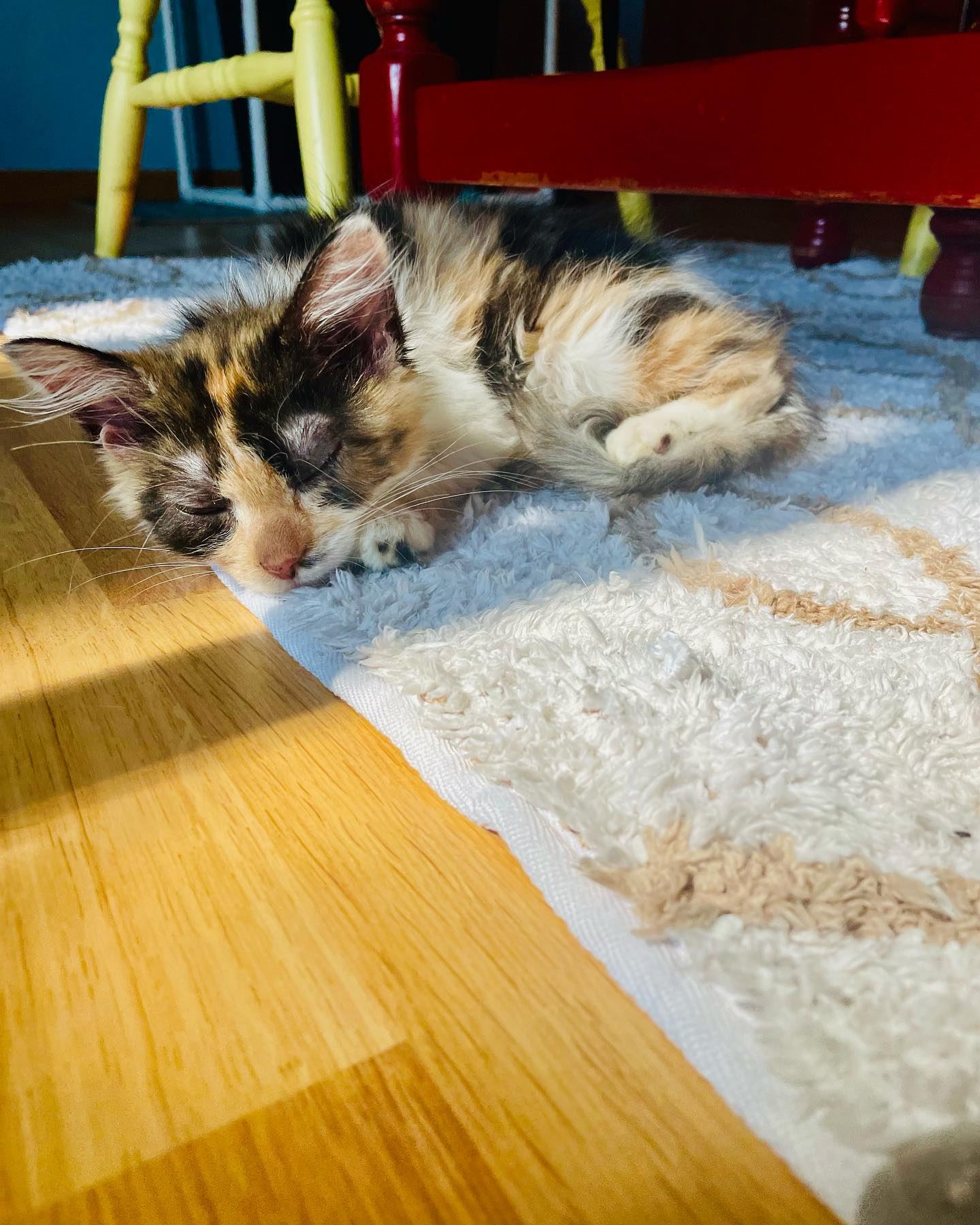
If it helps, here is a picture of our kitten, Gladys.

I am pulling out all the stops here, folks.

Calico kitten

Dementia at the Wedding Reception, the Winery, and the Martini Bar

Everybody has a story.

When you walk around this world and tell people you teach about dementia and started a dementia simulation house, everybody has a story.

And it’s my job to listen.

It’s a parent living with dementia who wandered away from home for two days before being found in a park. A nursing home that treated a loved one poorly. A neighbor who thought you were stealing his tools. A suspicion about your mom or your dad. Or yourself.

Many times there are questions. Why did he behave like that? Can you use the nursing home? How can I convince the neighbor I’m not stealing his tools? Do you think I should be concerned about my loved one? Or myself?

Keep in mind…these are conversations I have in passing. At graduation parties. At wedding receptions. At the indoor cycling studio where I coach.

You could say I should do better at keeping home/work boundaries and avoid these conversations. Or maybe have these individuals call me during work hours.

That’s not really how I’ve structured by life. It’s a choice. I jump into the conversation leaving my poor husband wondering if we’ll ever make it out of Target. (Bill, I appreciate the way you patiently wait for me to finish a dementia lecture in the cereal aisle.)

But here’s the thing….what am I interested in? I’d better say dementia, or I’ve take a wrong turn somewhere in life. These stories are interesting. And I learn.

There was a guy who said, “My wife has that dementia. It’s from all the time she spent breastfeeding. It messed with her brain.”

I learn I need to do a better job helping the public understand what may cause dementia, and what does not.

And the woman who told me, “My dad has both dementia and Alzheimer’s. Can you believe our bad luck?”

I learn I need to do a better job teaching the difference between Alzheimer’s and dementia. Alzheimer’s is one type of dementia. Everyone with Alzheimer’s has dementia.

In the middle of a wedding reception, a woman approached me and said, “I heard you’re the dementia lady. I want to know where I am supposed to turn after my husband got diagnosed. No one can help us.”

I learn we still have a long way to go in providing support services and making families aware they are available.

Once a gentleman asked me if dementia was contagious. The jaws of people lingering around dropped. I responded that it was not. And I realized that there are people who have not have an opportunity to learn about dementia.

In order to teach communities about dementia, I need to get a feel for what people know and don’t know. I’ll be honest. When I have conversations about dementia, I talk too much. And I don’t listen enough.

So I’ll start at the gym. At the wedding reception. At winery in northeast Iowa. At a martini bar. (Ask my friend Amy…sometimes I wonder why she wants to go out with me anymore. Sorry, Amy, for all the times you had to sip your drink and listen to me give a TedTalk to the bartender.)

Before you think I am trying to throw myself out there and suggest I’m a hero, stop. I know a lot about one particular topic and I want to share that info to help when I can. But, really, I am incredibly fortunate.

I have a few favorite topics….indoor cycling, pets, and dementia. All of them are part of my daily life. And y’all know I could talk about dementia all day, and so I do. Except when I am telling you about my two dogs and three cats.

My life is pretty cool.

Praying for the End in Dementialand

I was 23 when my grandpa passed away. He had a lot of chronic health conditions, including diabetes, and he’d recently had a leg amputated. The last time I saw him in person, he kept calling the guy I was dating at the time “Steve” (although his name was not Steve) and he was very grateful to “Steve” for helping him figure out the remote control to his crappy TV at the hospital. The last time I talked to him on the phone, he was telling me about a church picnic that he had attended. He mentioned he brought brownies in a basket. There had been no church picnic.

I remember sitting on the bed in my small grad school apartment with my black cat, Teela, as my mom called me to tell he that he died. It seems surreal that I still have Teela (although now she has three doggie brothers and a feline sister–oh, and a dad!) and am looking at her in her kitty condo as I type this today. It seems so long ago, but I guess it wasn’t that long ago because I still have Teela–although she is a bit heavier and moves slower…I could say the same about myself though.

I asked my mom if she thought I should call my grandma to express my condolences. To be honest, I wanted her to tell me not to bother Grandma. I was a little nervous to make the call. I didn’t know what to say. When Grandma answered the phone, she launched into a story about the Red Roof Inn she was staying at near my grandpa’s hospital. She had spent a lot of nights there, and they were kind enough to not charge her for the night my grandpa died. She was absolutely overwhelmed by their kindness. I think of this every time I see a Red Roof Inn to this day.

I didn’t really know what to say when she paused after praising the employees of the Red Roof Inn, so I blurted out, “I’m sorry about Grandpa.”

“Oh, honey,” she said. “I was praying for the Lord to take him. I knew he wasn’t gonna be strong enough to come home after losing that leg. It was the best thing.”

The best thing?

At that point in time, I had this idea that we all should fight for our lives to the bitter end. I saw death as failure, not as a natural part of life. And I wasn’t sure what I thought of someone hoping and praying for a loved one to pass away.

In a way, I was glad my grandma accepted my grandpa’s death on some level. On the other hand, I couldn’t wrap my mind around the notion that my grandma prayed for my grandpa to die. I can assure you that the experiences I have had between then and now have absolutely allowed me to wrap my mind around this.

I was speaking with a woman recently whose husband has a type of dementia that can progress very quickly. I pointed out that this rare type of dementia has a shorter life expectancy than Alzheimer’s and most other types of dementia. I had only known this woman for about…3 minutes…so I worried that I’d said too much and was perhaps being a bit pessimistic and blunt when I had no idea where she was at with this.

“Oh, thank God,” she said. “The quicker this progresses, the better.” Then she looked horrified, like she couldn’t believe she said this to me.

There are many people who live well with dementia. Unfortunately, her husband is currently not one of them. And she wants this over as soon as possible, for him and for her.

Then she asked, “Am I a bad person for wishing he dies sooner rather than later?”

I wasn’t quite sure how to respond. It seemed like a question for a ethicist, pastor, or philosopher rather than for me. All I could do was reassure her that her feelings were normal considering the circumstances. She was absolutely right that he seems to have little quality of life. He spends most of his day in their bed–but with his eyes open–and he gets upset if she tries to turn on the lights or the TV. He recently told their kids that he was sorry he ever had them, and he had even become aggressive toward one of his grandchildren. She also pointed out that he’d be really upset if he realized that all the money he had worked so hard to save would likely be eaten up by a nursing home.

So, are you a bad person for hoping that your loved one with late-stage dementia passes away rather than lingers on? Absolutely not. This is normal. It’s also normal that you might wish for them to pass away in one moment but in the next minute be willing to do anything to keep them on this earth.

And when they do die, it is normal to feel guilty that you wished that they would pass away and then want them back. It is normal to feel a variety of emotions when a loved one with dementia dies, but one of those emotions may be relief. And–no–none of this makes you a bad person. It makes you human.

If someone says to me that they want their loved one to “go quickly” or “leave soon” or any other euphemism we can use to avoid the actual term “death,” it may be partially from a selfish place–because being a care partner is demanding.

However, I find that more frequently it has nothing to do with the care partner and everything to do with the person with dementia. While some people with dementia live a life worth living right up until the moment they depart, we cannot say that everyone with dementia has a positive quality of life from dementia to death. It’s just not true. Alzheimer’s, Huntington’s, Lewy-Body Dementia, frontotemporal dementia…these can be cruel diseases.

When we look at our loved ones and see depression, anxiety, and pain (physical and emotional), we may hope for death. Don’t beat yourself up if you pray every night for God to peacefully take your parent, spouse, or sibling. No judgment here. And if you attend a dementia caregiving support group and mention that you are ready for your loved one to pass away, you will see a chorus of nods and knowing looks.

I fully anticipate that this post will offend someone. And I am offended as well. I am offended that dementia causes such suffering that one would at some point hope for death for a family member or friend–and that as a society we haven’t been empathetic or supportive enough to those in the midst of this journey.

Why We Can’t Afford to Accept Dementialand (And What the General Public Hasn’t Yet Figured Out)

I think I’ve given someone the wrong impression about how I feel about Alzheimer’s and related dementias. Someone the other day said to me, “I think you’re right. We just need to accept that old people get dementia and lose their memories.” Hmmmm….. I took a deep breath. It’s not just about old people and it’s not just about memory loss.

Also, I think a point of misunderstanding here is how I’ve used the term acceptance in my blog and public speaking. When someone has dementia, we need to accept the changes the occur. Fighting those changes is a bit like try to herd cats (inefficient and frustrating for all involved).

But should we accept Alzheimer’s and related dementias? Absolutely not. We should fight by increasing education and research. We cannot afford (financially or otherwise) to throw in the towel on this battle.

I could make a case that we need to find a cure or prevention method for diseases that cause dementia because these diseases (e.g., Alzheimer’s, Lewy Body Dementia, Frontotemporal Dementia) cause suffering and end lives. But I am going to take a different approach–one that may be more appealing to legislators, policymakers, and economists.

If Alzheimer’s and related dementias progress to end stage, most individuals need 24/7 care and reside in nursing homes. Keep in mind the most common reason for nursing home admittance is dementia. If we can prevent or cure dementia, more people will be able to stay in their homes (or at least seek out a less intensive care option) as they age. Most people would choose to stay at home given the option. We don’t like to be dependent. We don’t want to be told when and what to eat. But beyond that…nursing home care is expensive at the individual and societal level.

Some people have enough personal wealth to pay for their nursing home care until the end of life. A few people have long term care insurance (and some of these individuals quickly find out that their policies do not cover what they expect they will). But the rest of us….

The rest of us pay until we can’t pay anymore, and our family is decimated financially. At this point, the state pays for our nursing home care. (Contrary to popular belief, Medicare only pays for nursing home care in very limited short-term cases.) As people live longer and more individuals have Alzheimer’s and related dementias, as a society we will struggle to pay for care. And I think the word “struggle” is an understatement.

The cost of nursing home care is dependent on where one lives and a few others factors (e.g., semi vs. private room, level of care). However, a widely-reported mean is $220 to $250 a day. This adds up to $80,300 to $91,250 a year. And you thought college was expensive. Very few of us can pay for an extended stay in a nursing home without long term care insurance or state assistance. And it’s rare that people have long term care insurance because it’s expensive and you have to be pretty healthy to qualify. Sometimes in the end it turns out to be a rip off anyway.

I’m not sure legislators understand the financial crisis this will create. In fact, I have participated in three informational panels for state legislators to learn more about the need for funding for research and support for Alzheimer’s and related dementia. Each time I came in my business suit (a rarity for me) prepared with financial numbers and statistics. The total number of legislators that attended the three sessions combined: Three. Actually, make that two. One legislator attended two sessions, and it’s misleading to count him twice. The general public doesn’t get that this is an impending financial and public health crisis, and apparently legislators don’t get it either.

In my opinion, the biggest challenge we face when we try to rally support for Alzheimer’s and dementia funding is combating the myth the dementia is only about memory loss. The general public still thinks that dementia is the natural process of increasing forgetfulness that occurs as we get older.

First of all, dementia is not normal aging. (And I will add the dementia doesn’t only impact old people. I know people in their late 30’s with Alzheimer’s and related dementias.) There are some normal age-related memory changes, but these normal changes do not severely impact daily life.

I speak to many older women who worry they have dementia because they used to be able to bake their signature cake from memory and now they need to look at the recipe. Sometimes people think they have Alzheimer’s because they used to be able to remember several items at the grocery store without writing them down. Now they need to write a list. Those are normal age-related memory changes. When we have these changes, we can use strategies (e.g., recipes and lists) so that they don’t negatively impact our lives. These strategies may work at the start of dementia, but over time a person becomes incapable of following a recipe or creating a list.

The other piece of the myth of dementia that has held us back in terms of research and funding is the incorrect assumption that this is just about memory. Memory loss is one part of dementia. I hate to be this harsh, but dementia is about eventual complete and total brain failure. Take a second and think about what your brain controls…. Actually, it may be easier to think of what your brain doesn’t control. Your brain is the control center for EVERYTHING about you.

What does your brain control? Your mood. Your movement. Your memory. Your swallowing. Your immune system. Your impulses. Your breathing. Your speech. Your language. Your non-verbal communication. Your facial expressions. And this is by no means a complete list.

So here are some things that may happen with Alzheimer’s and related dementias that are not memory related:

1. People with dementia might eat things that aren’t edible, like marbles or rubber bands. They might not realize the food they are eating is spoiled or that it’s not prepared (e.g., eating cake mix or raw eggs).

2. Dementia can cause a person to have issues with balance and movement. It is common for dementia to cause someone to be unsteady on their feet and fall down stairs. Eventually, it can progress to the point that the person can no longer walk. At the end stage, people are bed bound and pressure sores are problematic.

3. An early sign of dementia is being unable to detect sarcasm. A person with dementia may also be unable to figure out that someone is lying even when it is apparent to others.

5. Compulsive behavior (such as repeatedly locking doors or buying a large number of food items even though the pantry is already stocked) can be a sign of dementia. Someone who starts pacing around the house compulsively might have dementia.

6. A lack of eye contact during conversation or inappropriate staring in public places might be a sign of dementia. A person’s non-verbal communication skills can become compromised.

7. Often dementia is mistaken for depression. Many people go to the doctor early in their disease process and are misdiagnosed as having clinical depression. This can be tricky because, not surprisingly, people who have dementia are often also depressed.

8. Dementia impacts the part of the brain that regulates mood, so being moody or displaying inappropriate moods can be a sign of dementia. If someone starts laughing at things that aren’t funny, they may have dementia.

9. Dementia can impact swallowing, and individuals are at an increased risk for choking. Often families must make a decision about whether or not a feeding tube is an option. People at the end stage of their illness may also aspirate on oral secretions.

10. At the end stage, the immune system is compromised. The brain activates the immune system. As brain cells die, the immune system doesn’t respond as it should. It is common for someone with end stage Alzheimer’s to die of a urinary tract infection that has spread.

It’s not just about memory. It’s not normal.

And we can’t afford to just accept Alzheimer’s and related dementias. It’s time to fight.

Before and After in Dementialand (Or Why I Watch TLC and HGTV)

I was talking to some friends a few weeks back, and the TV show My 600-Pound Life on TLC came up in conversation. It’s a reality show about super-obese individuals who get weight loss surgery and attempt to change their lives for the better.

For some reason, I was hesitant to admit to my friends that I watch the show. I wanted to say I had never heard of it. I wanted to say I had no interest in watching a reality show like that. Yet, the truth is that I have a season pass on my DVR. I started thinking about what it was about this particular show that I enjoy, and I finally realized why it appeals me. I love a good before-and-after.

I used to watch What Not to Wear. I DVR’ed that one as well. I would watch the beginning but then fast forward to the end. I didn’t care about all the shopping and hair talk in the middle. The make-up tips didn’t interest me. I only cared about the before and the after.

I’m really not that into homes, design, or decorating, but I watch a bunch of shows on HGTV. Why? Because I enjoy the transformation. I love the idea of taking something that is in shambles and making it something wonderful. I also have somewhat of a crush on the Property Brother that does the construction. (The one that does the real estate number-crunching stuff just isn’t my type.)

I really get into those house-flipping shows. There’s Flip or Flop, Rehab Addict, Fixer Upper… If you know me at all, you know I have no interest in flipping a house. If I ever talk about flipping a house, please do an intervention. I like the idea of flipping a house, although it’s not something I have the skills to pursue. I just like the notion of transforming something into something much better. It’s about the before-and-after. The before is dull and drab. The after is bright and shiny.

I also watch Intervention on A&E for the before-and-after effect. Someone might be a drug addict before but maybe–just maybe–they can be a productive member of society after. There a certain level of hope in that.

In grad school, I lived with my friend, Lisa. We would watch Intervention every Sunday at 9 pm. Exactly at 9:40 (as the family was just gathering for the intervention), Lisa would say it was time for her to go to bed. It still bothers me that she didn’t get to see the after of all those drug addicts. Why watch if you don’t get a chance to see the after? Couldn’t she stay up past her bedtime just one night a week? (As a side note: Lisa was a pretty great roommate. My only complaints about her are that she wouldn’t watch the end of Intervention with me and she had the willpower to eat only one cookie per day out of a huge bag in the freezer.)

Families impacted by dementia are often caught up in the before-and-after. There are the years before dementia. Then there’s the after. Everyone with dementia is different, and dementia affects everyone in a different way. But there’s no doubt that the after is not the same as the before. (A person with Alzheimer’s once said to me, “I’m still me but I’m a different me.”)

When I meet someone with dementia that has progressed past the earlier stages, I notice that their family often needs to tell me about the before. Maybe she used to be a successful real estate agent who could sell any house in a week. Maybe he was a teacher who touched a thousand lives. Maybe he was a cop or a firefighter who selflessly served his community. Maybe she made the absolute best apple pies on the face of the earth.

And I always listen when they tell me about the before. There is value in knowing about the before. It helps us to connect with an individual with dementia when we know where they’ve been, but I feel like the family is sometimes telling us this for a different reason. They are telling us about the before because the after isn’t enough. They want us to understand that this person is more than what we see in front of us.

I once met a woman with Alzheimer’s who had been a fantastic golfer. She and her husband traveled around the country playing in golf tournaments. Her family told me that she had been incredibly competitive…to the point where she would trash talk other female golfers. Her kids told me that she didn’t make a lot of friends on the golf course, but she won a lot of huge trophies which now decorated her room at the memory care community as reminder of her before. She once told an employee that she won all the trophies for having the largest cow at the state fair. Obviously, they didn’t hold the same meaning to her that they did to her family. They were a before thing. She was in the after.

As her Alzheimer’s progressed, she could no longer go out and play nine holes of golf. Her kids started taking her to the driving range until she was unable to do that. After she moved into memory care, a creative staff member went to Walmart and bought a few items so they could set up a mini-golf course in the hallway. The woman lit up like the staff had not seen before. The ball never went in the hole, but she would putt up and down the hallway for hours.

The staff expected her family to be excited when they arrived and saw how much fun she was having. They were not excited. In fact, they were angry and saddened. They thought it was demeaning that a woman who had once been a competitive golfer was now aimlessly pushing a wiffle ball up and down the hallway with a plastic golf club. They were caught up in comparing the before to the after.

I realized recently that my love of the before-and-after does not extend to working with individuals with dementia. It’s not that I don’t care about the before. It’s fun to hear about a person’s past, and the before holds some keys to what might work when you try to improve the qualify of life for someone with dementia. Most importantly, no one wants their life to be forgotten. We want to know that people will remember what we did and how we did it. We want to know that what we’ve done has been meaningful and worthy of remembering–especially if don’t remember it ourselves.

Although we should remember the before, we also need to let go of it. If we don’t let go of the before, we can’t appreciate the after. This is easier for a professional caregiver than a family caregiver. Professional caregivers don’t have a before in their mind when they work with someone who has dementia. Family caregivers often can’t get the before out of their mind.

I have recently realized that I must not be the only person who enjoys TV shows based on the before-and-after concept. There’s Restaurant: Impossible, Biggest Loser, Extreme Weight Loss, Flea Market Flip….You can probably name many more if you think about.
But there is no before-and-after reality TV show about Dementialand. I’m not sure how many people would tune in. When the after isn’t always bright and shiny, sometimes the show loses its appeal.