Tag Archives: caregivers

AND THE GUILT.

If you’re caring for a partner with dementia, hear this: You are not alone in your guilt.

You feel guilty.

Guilty for feeling lonely, even while your spouse sits right beside you.
Guilty for missing the conversations you used to have with your partner.
Guilty for wanting just one day when you don’t have to be the responsible one.
Guilty for snapping, for sighing, for thinking, I can’t do this another day.

Sometimes the guilt cuts even deeper:

  • Guilt over placing your spouse in a memory care community.
  • Guilt for making promises you have not been able to keep.
  • Guilt because your wedding vows echo in your ears—in sickness and in health—and you feel like you’re failing.

You are not failing.

Dementia can be a cruel thief. It steals conversations, shared memories, inside jokes, quiet comfort, and the daily rituals that make a marriage feel like home.

But here’s what it can’t steal: The fact that you have loved, and that you still love, even if that love looks different now.

Your love isn’t gone. It’s changed. But it’s still there.

Placing your spouse in care doesn’t mean you’ve stopped loving them. It means you’re protecting them. It means you’re protecting both of you.

Needing space doesn’t mean you’re abandoning them. It means you’re human.

You are grieving losses that happen while your spouse is still physically here—a grief that’s invisible to many around you. The stuff that makes your heart drop….it doesn’t even make sense to other people. And maybe you’ve stopped even trying to explain it to them. This is your journey, and it’s unique.

So if guilt is knocking on your door today, gently remind yourself:

You’re still here.
You’re still loving.
You’re still trying.

That’s enough.

And you deserve compassion, too.

More Education = Better Care!

I am happy to do dementia trainings for various sectors, but I am always honored to be asked to train staff at nursing homes and memory care communities.

I am honored because the employees I work with are generally CNAs or resident aides, and I would argue that how well they do their jobs is one of the most important factors–if not the most important factor–in quality of care.

Has it ever occurred to you in nursing homes and assisted livings that the people who are paid the least have the most direct contact with the residents?

I am continually amazed at the varying levels of dementia knowledge of employees.

I am surprised by how much people know. I am surprised how little people know.

And level of knowledge, anecdotally, doesn’t seem to be related to experience in the field.

In the state where I live, employees who work with those living with dementia have to do an online module to learn about dementia and meet the state requirement. And that’s it.

If you or a loved one are considering care, a great question to ask is, “What type of ongoing dementia education does your staff receive?

Research shows that facilities that invest in more dementia education for staff provide better care to residents. That’s not surprising, is it?

Dementia education….works.

Training programs for staff have been shown to improve staff-resident interactions, increase staff empathy for residents, and create more meaningful engagement with those living with dementia.

Dementia education increases staff knowledge, improves attitudes toward people with dementia, and boosts confidence of those providing care. They not only benefit residents but also positively impact staff by increasing job satisfaction and reducing burnout. 

If you want to look at the research studies, let me know, but the evidence is overwhelming.

Dementia education is linked to improved dementia care.

There is research about what types of education and delivery methods are most effective. When I plan a training, I go back to this research in designing something to meet the needs of the facility. I don’t deliver a cookie cutter training.

Not surprisingly, standard online modules (aka cookie cutter trainings) are not recommended as the best form of dementia education. However, I understand that facilities are challenged by staff turnover. I can’t come to your facility every week to train new employees. I get it.

Facilities are doing the best they can with the challenges and limitations that exist in the industry. Long term care is incredibly complicated.

Dietary staff, CNAs, resident aides, maintenance, and everyone else….You are doing a hard job and we need to give you the tools to succeed. And I want you to enjoy the important work that you do!

A friend of mine recently went with her father to explore an assisted living that serves those living with dementia. Her father is in the early stages of Alzheimer’s and wants to put a plan in place. (Can I just say–good for him!)

The assisted living was beautiful. A grand lobby. An enviable coffee bar for the residents. The resident rooms were spacious.

My friend, at my suggestion, asked what type of ongoing dementia education is required for staff.

She was told that they do an online module within 30 days of their start, and then yearly they must complete more online training. That’s in compliance with the state law.

My friend asked if they had opportunities for ongoing education. The response was that there was a lot of stuff out there on Tik-Tok now that shows how to “treat dementia people.”

After more conversations with other employees from the community, she was not convinced that providing excellent dementia care was a priority.

She heard some of the employees using non-dementia friendly language in chatting with her.

“Dementia person”

“Dementia sufferer”

“Senile”

People who work in facilities like this should be educated on dementia friendly language.

Despite the beauty of the building, they decided it wasn’t a fit.

While it is frustrating that some nursing home employees have a low level of knowledge about dementia, that lack of knowledge isn’t their fault. People know what we teach them. Let’s teach them.

Here’s the thing about work trainings. They can be dry and boring. I promise that I am not dry and boring. I may be weird and loud but not dry and boring.

I want employees to leave MORE excited about working with residents. I want to teach them to find the joy in their jobs and celebrate the wins. I want them to gain confidence and know that their employers in investing in them.

It’s not just about what I do, of course. There are other qualified individuals who do dementia education. (Make sure you check their qualifications and education!)

Turnover among nursing home employees in challenging for communities. If we can get people to enjoy working with those living with dementia, turnover decreases, the facility saves money, and staff provides better care.

To communities that make continuing education a priority…you deserve recognition. People should know that you are taking steps to invest in and educate your employees. Please talk about this when you market your community. It’s important.

Your commitment to education and, consequently, providing better care is admirable.

The Who, When, and How: Telling People You Have Dementia

Sometimes I have to check myself.

Sometimes I attempt to make things simpler than they are.

Once in a while, I am asked by someone if they should share their diagnosis of Alzheimer’s or another dementia with family, friends, co-workers, or community.

Example: A while back I chatted with a couple. The husband had been diagnosed with Alzheimer’s. They were uncertain about who they should tell. In the six months since diagnosis, they had told no one–not even their kids or closest friends.

They asked me if they should tell people.

I said yes.

I didn’t say, “Shout it from the rooftops,” but I might as well have.

When I spoke with them again recently, I asked who they had told. They looked at each other and seemed to not want to admit to me that they hadn’t told anyone.

My first thought was to tell them it was time. So I did.

It was time to tell others so others that others could support them.

But then I stopped. I realized that I sounded like I was disappointed in them. Like they were kids who had not done their homework.

I had to back up and think about all the reasons why it’s hard for people to disclose a diagnosis of Alzheimer’s or another dementia.

When I told them to tell people, I was ignoring a host of contextual factors.

So why don’t people disclose their diagnosis?

  1. Some people are just private people. And once the news gets out there, it’s out there. You can’t take it back.
  2. Individuals living with dementia may fear that disclosing their diagnosis will lead to others questioning their independence or capabilities.
  3. Each person copes with a dementia diagnosis differently. For some, keeping the diagnosis private allows them to process their feelings without external pressures or judgments. It may take some people longer to open up about the diagnosis.
  4. In some cultures or families, discussing health issues may be seen as inappropriate.
  5. A dementia diagnosis can feel like a loss of control over one’s life. Keeping the diagnosis private allows individuals to maintain some level of control over their situation.
  6. Maintaining a sense of normalcy in daily life can be crucial for individuals with dementia. They may want to continue engaging in social activities, work, or hobbies without other people reminding them that they have dementia.
  7. Many people fear that disclosing a dementia diagnosis could alter the dynamics of their relationships. They might worry that friends and family will treat them differently—either with excessive concern or a lack of confidence in their abilities.
  8. Individuals may choose to keep their diagnosis private out of a desire to protect their loved ones from emotional distress.
  9. Let’s face it. There is still a stigma that comes along with dementia. It’s a medical condition–yet many associate it with incompetence and lack of intellect.

And, for all of those reasons and others, I have to understand that I cannot tell people what they should do.

I want to encourage people to let others know when they need support. You can’t expect support when people are in the dark.

And yet, I cannot dictate the who and the when and the how.

Also, in my perfect world, when you tell others you have dementia, you get support. I know that’s not always true. Sometimes you tell people and they let you down.

I did happen to ask that couple why they had not told anyone about his dementia. Their daughter was getting married in a few months. They wanted to wait until after the wedding.

I wanted to tell them they should tell people before wedding in case they needed a little extra support during that time….. but I didn’t.

Because I don’t get to tell them what they should do.

Empower Dementia Strategies: Zoom Consultations for Families

By request, I’ve decided to start doing a limited amount of Zoom consultations for families impacted by dementia…and I started a company called Empower Dementia Strategies.

I’ll also be doing trainings and consultations for senior living facilities, as well as creating handbooks, manuals, and other resources for employees who work in dementia care.

I’m still working on branding, social media promotion, and all the other stuff I need to do that I’m not that good at. I am knowledgeable about dementia and relatable when I talk about it, so perhaps I won’t get too fancy with the marketing and will allow my reputation to speak for itself.

You can read more here: https://elaineeshbaugh.org/consulting/

And if you are interested in doing a Zoom consultation with me, you can fill out this form: https://forms.gle/AnrVt7oeE4y3ugTE6

Feel free to email me at dreshbaugh@gmail.com.

Dementia Friends Zoom Training (February 17 @ 6pm CST)

Hey all!

I will be doing a zoom Dementia Friends training through Dementia Friends Iowa (https://dementiafriendlyiowa.org/) on Monday, February 17, at 6 pm CST.

What will you learn at a Dementia Friends training? We will cover the basics of dementia, how it affects people, the different types of dementia, key signs and symptoms, and most importantly, how to interact with and support something living with dementia.

You can sign up here:

Sign up for virtual Dementia Friends!

If this session doesn’t work for you, you can find more opportunities here with various (and awesome) trainers across the state:

Become a Dementia Friend!

It Goes On

Her husband had Alzheimer’s, so she became a caregiver. She never wanted to be a caregiver. It’s not like she filled out an application for this job. It’s just what you do when your partner has dementia.

She described it as a roller coaster of a journey, and she resented the trip. There were moments of joy. There was a lot of laughter. But overall she felt cheated. Cheated out of the trips she and her husband planned for after retirement. Cheated out of how she thought she and her husband could provide childcare for the grandkids. Just cheated.

She wanted some time to herself, but she never seemed to have it. She wanted her kids to come over and stay with their dad, but they never did. She told her friends she dreamed of being able to wander around Target aimlessly on a Sunday. And sometimes all she wanted was to be able to take a hot bath without her husband walking in and needing help with something.

She wanted to sleep through the night but hadn’t in a few years. She wished she had the time and energy to put in an old fitness DVD and do a workout. Her friends invited her to go out for dinner once in a while, but they knew she’d say no. Eventually they stopped asking.

Then her husband died.

And the strangest thing happened.

She didn’t know who she was.

Every other role in her life–friend, volunteer, mother, grandma, neighbor, reader, traveler–now seemed unfamiliar and uncomfortable. And she found herself yearning to be a caregiver again.

There was a sense of relief, of course, when she had more freedom. But she also just felt empty.

She didn’t realize it at the time, but the caregiver journey–as difficult as it had been–was a journey that made her proud. She had been a great caregiver to her husband. She felt a sense of accomplishment. When she looked back, she realized that her years of caregiving for her husband were sacred and meaningful.

And yet she still felt resentful and cheated.

But she’d go back.

If she could rewind time and re-live those experiences of bathing her husband and brushing his teeth and making sure he ate, she’d do it in a heart beat. It was exhausting. And frustrating. But it also gave her this feeling of warmth and purpose. It was like she was put on this earth to care for him. And she did care for him. She fulfilled her mission.

She had a hard time finding another role that gave her that sense of purpose. Being a grandma was fun, but her grandkids were getting to the age where they didn’t need her. She started going out with her friends but felt isolated because they couldn’t really relate to what she’d been through. She did some solo travel but it just made her realize that no one really needed her.

And she’s still figuring it out. She signed up at a gym and is doing some group exercise classes. She wants to volunteer at a hospice but the training isn’t for another month. She brings snacks to her grandson’s soccer games. She’s doing some reading on finding a purpose and living a meaningful life and makes fun of herself for the stack of self-help books on her nightstand.

She knows she will get there. She’s surprised that the hardest role she’s even taken on is so hard to let go. She hated all the stuff she now misses, and it doesn’t make sense. She’s angry at herself for not finding more joy in the daily caregiving grind.

We are all constantly re-defining our role and purpose in this life. We are all searching for meaning.

But she’s really doesn’t know why she’s here now, and she has faith she will figure it out in time.

And this brings me to one of my favorite quotes:

In three words I can sum up everything about life: it goes on. –Robert Frost

Just Say No to Comparison

It’s the holidays, and my gift to you is that you will hear from me frequently. Just kidding.

Well, not kidding about hearing from me frequently, but kidding about it being a gift. Hopefully you have higher expectations for gifts this year.

But I am here. And I wish I could do more for those of you who read my blog regularly. I appreciate you, and you deserve the best possible holiday season. Maybe you don’t know how to make that happen. Maybe you are flying by the seat of your pants. But I am here and I am rooting you on.

Because the holidays and dementia. It’s a lot.

The holidays are hard. They can be joyful, peaceful, fulfilling, as well. They can be more than one thing.

They can be sad and rewarding. They can be difficult and joyous. They can be depressive and happy. They can be any combination of anything.

It’s not an either/or.

You get to feel whatever you feel, and it may be all over the place if you live with dementia or are a care partner. Or if you’ve lost someone recently. Or even not so recently. Or if you’re divorced or struggling with chronic illness. Or if you are struggling financially. Or if you are going through IVF.

It seems like many of us have complex situations that put us on the holiday struggle bus.

And we watch Hallmark movies (well, I don’t because the plot is the same every time and I am the least romantic person on earth) and have these expectations that our holidays will end on a happy note with a bow wrapping it all up. And then those sappy commercials with those happy harmonious families celebrating together…

Comparison is the thief of joy.

I didn’t make that up. I just Googled it, and it sounds like the quote is attributed to Teddy Roosevelt.

If you prefer, “Comparison is the death of joy” is attributed to Mark Twain. I will go with the Mark Twain version because I lived in towns on the Mississippi for the first 18-ish years of my life.

When we talk about comparison in this context, we think of the comparison between ourselves and others. The comparison between our holidays and the holidays of our neighbors. Our meager light display and the full-blown light show down the street with that giant blow-up reindeer.

Your family has been impacted by dementia. You might look at families you know and even families on TV and in the movies. Your family is different than those families. You will celebrate the holidays in a different way than other families.

When we try to mimic other families, we are often disappointed. We are not them. Even at times when we don’t want to be us, we are still us.

Sometimes the comparison that kills your joy is your comparison of past and present. The holiday season now versus the holiday season 5 years before Mom’s diagnosis. New Year’s Eve last year when Dad was around to celebrate versus now when you watch the ball drop without him.

Sigh.

Your family is not only different from other families but different from how it used to be.

It’s an obvious statement. But think about it for a sec.

Maybe the rituals you’ve always found important, like midnight mass or the all day holiday gathering with the grandkids, don’t work anymore. When you are different, you need to change.

Don’t put square pegs in round holes.

Even if your peg used to be round.

I didn’t make up the first part (although I can’t find who I should credit) but maybe I made up the second part.

Have the best possible day.

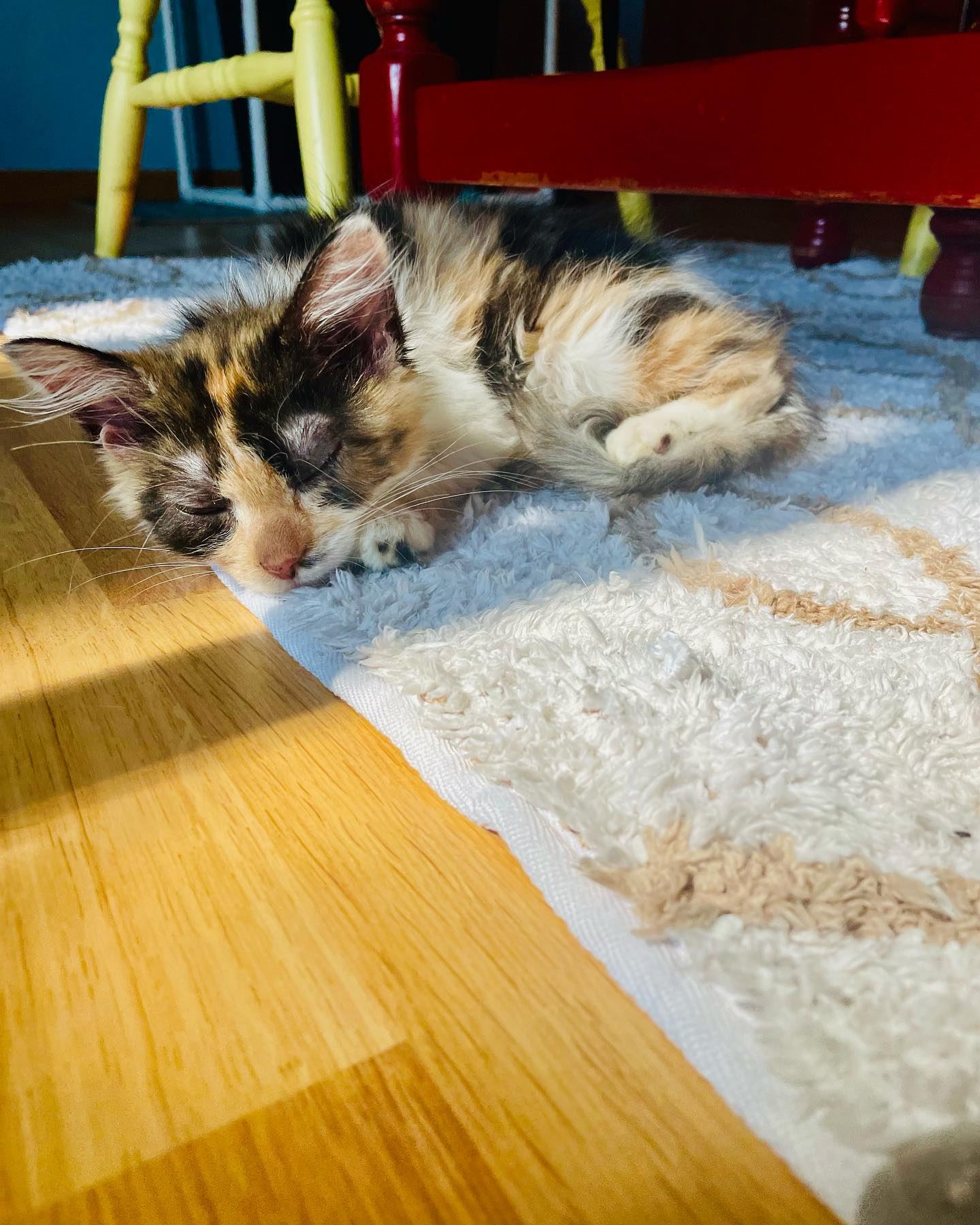
If it helps, here is a picture of our kitten, Gladys.

I am pulling out all the stops here, folks.

Calico kitten

Dr. Eshbaugh’s Christmas Letter (aka Give Yourself a Break and Change Your Expectations)

Dear Friends,

This is the closest thing to a Christmas letter I will write this year, and it is to those of you who live with dementia and those of you who are caregivers.

First of all, it doesn’t matter to me what you celebrate. Hanukkah. (Obviously I don’t celebrate Hanukkah because I looked up how to spell it and it still doesn’t look quite right.) Christmas. Winter Solstice. Festivus. National Eggnog Day. Maybe you don’t celebrate anything, and that’s fine with me. Maybe you usually celebrate something but don’t feel like celebrating this year. I’m not here to judge.

If you choose to celebrate something this year, I encourage you to be flexible. I encourage you to be patient with yourself and with others. I encourage you to accept that life is changing. Perhaps some holiday traditions will continue, whereas others will not. That’s okay.

Remember you can say no.

Yes, I am talking to YOU. You can say no.

If someone invites you to an event, you get to decide whether that event is going to work for you. Maybe it will be too loud, too crowded, too long of a drive, too time-consuming, too intense. Maybe it’s at night and your loved one with dementia typically goes to bed early. Perhaps you’re a caregiver and you just don’t have the energy. All of those are legitimate reasons to say no.

You can say yes–and then change your yes to a no when your loved one with is having a rough day. If someone judges you, they don’t understand dementia. People living with dementia have bad days, and on bad days some things might just not be possible.

Church services, especially crowded ones, can be stressful for someone with dementia. (Not to mention that whole COVID thing, right?) Can you live stream the service? Or organize a short candlelight service for your family at home? Maybe your family has gone to Midnight Mass every Christmas for 40 years. Perhaps that just doesn’t work this year. It’s okay.

Maybe you don’t need to volunteer to host the family holiday party. You say you’ve hosted it for 30 years? Sounds like you’ve paid your dues and it’s someone else’s turn. You know what’s great about NOT hosting? You can leave!

On that note….

Have an exit plan. If someone with dementia is having an off day, they may only be able to stay 30 minutes at family Christmas. This is why you always drive separately. Don’t ride with Aunt Jean and Uncle Tony. They might want to stay all day. Don’t let anyone guilt you for an early exit. I give you permission to pull one of those sneaky exits where you don’t say goodbye. If you need to leave, just leave.

Is there a place you can crash for a quick break or nap if the gathering is overwhelming? Can you escape to the basement for a deep breath if the grandkids are out of control with their ridiculously noisy and obnoxious toys? Don’t be afraid to step away. Keep in mind that a gathering like this can be anxiety-provoking for someone with dementia who may not recognize everyone (who are these people and why do they want to hug me?) and be sensitive to noise.

Giving cash or a gift card always works if you aren’t up for shopping. It is okay to order pizza on Christmas Eve. I am guessing no one will miss your holiday card that much if you don’t send one. And those delightful platters of high calorie treats that you bake and deliver to your neighbors? They will survive without them.

Not that I speak from experience or anything, but if you aren’t up for wrapping gifts, gift bags are great. I’ve also been known to just hand people their gifts in a plastic Target bag. Tacky? Maybe. But I’ve never had anyone refuse the gift because it wasn’t wrapped.

Maybe this is the first year that you celebrate the holidays at the nursing home with Grandma because taking her home causes too much confusion. Two or three of you visit at a time. Having a large group seems to cause anxiety. And then you have your family Christmas bash at home without her. You feel like an awful person, but you’re not. Sometimes your best option just isn’t all that good. We do the best we can.

So that’s it. Give yourself a break. Change your expectations. And, happiest possible holidays!

XOXOXO,

Elaine

Caregiving is Hard Because It’s Hard

I want to acknowledge something that we “professionals” do to dementia caregivers.

We have good intentions, of course, but you have every right to roll your eyes at us. We preach taking a break. We tell you that respite will do you well. We say that you need to reward yourself with some self-care.

Great recommendations, obviously. But perhaps it sounds like we don’t know your life.

A break? I am supposed to take a break from what….my life? I don’t see anyone waiting here that’s ready to take over my caregiving responsibilities.

Self-care? How can I take a bath when my husband who has Alzheimer’s might wander out the front door and get lost?

A vacation? What a joke. I would be so stressed out being away from my loved one. And my partner had to quit their job when they were diagnosed so we don’t have the money.

Sure, I recommend you do your best to set up some supports so you’ll have more options. An alarm system? A neighbor to stop over? A short weekend trip if you can find a family member to stay with your loved one?

But I get it.

It’s not that easy.

Meditation? Yoga? Great options. But, as a women once told me, “Meditation is great…until my husband starts screaming and crying because I am in another room and he can’t find me.” The reason you most need meditation may be the reason you can’t make it happen.

As a dementia caregiver, you tell people you’re struggling, and they tell you to get a massage. Or maybe a facial. Or to go shopping to relieve some stress. They tell you that you look tired and you should work on getting more sleep. Ha. These people mean well, but I worry their message carries blame.

You are stressed because you’re not doing these things.

Yep, caregivers, just another thing you are messing up.

But, my friends, you are not struggling and stressed because you’re doing something wrong. It’s because….dementia isn’t easy. Your life isn’t easy. And that’s the nature of the beast here.

Caregiving is hard. You are not stressed because you need a nightly bubble bath and a yoga class. You are stressed because caregiving is hard.

That deserves to be acknowledged.

Mirrors, Strangers, and Friends in Dementialand

When I was a kid, my mom worked at a nursing home. I remember one particular incident like it was yesterday–although it was (gasp) about 30 years ago.

My mom, a resident, and I were walking down a hallway. There was an expansive mirror on one side of the hallway. The resident had taken a fall a few days before. The fall had left her with nasty black eye and bruising all over one side of her face.

The resident caught a glimpse of herself in the mirror and froze. I thought she was about to make a comment about how awful her face looked, but she didn’t. She didn’t even know it was her face.

“What the hell happened to that old bag?” she exclaimed.

I remember being fascinated with how this person could look in a mirror at herself and think it was someone else. As I sit here thirty years later, I still find this one of the saddest, scariest, and most interesting things about dementia. Seeing a person look in the mirror and not recognize themselves always takes my breath away.

I know a man who accused his wife of cheating because this old guy showed up in their bedroom at night. I recently talked to the daughter of a man who refuses to take showers because he is sick of a creepy dude watching him. A woman at a local nursing home thinks that the woman in the mirror is actually the woman in the next room, and she keeps telling that woman to find a hobby instead of sitting there all day. And I know multiple individuals with dementia who have told family members that people are breaking into their homes. A few have even called the police.

A woman in a support group told me that one day she walked into the bathroom to see her mother washing her face–except it was the face in the mirror. She was getting angry that the woman wouldn’t stay still.

Mirrors are confusing and often agitating for people with dementia. There’s an easy solution, of course. You can take them down. In a family home, curtain rods can be placed over mirrors so that they have adjustable curtains or drapes.

I do know several people with dementia who have made friends with the figure in the mirror. One man chats away to his buddy as he brushes his teeth and bathes. He seems to think it’s someone he served with when he was in the Navy. Another women I know is convinced it is her mother who stares back at her, and she finds this comforting.

The grandmother of one of my friends used her friend in the mirror to reinforce her own opinions. My friend would walk into the nursing home room, and her grandma would say something like “Your shirt is too low cut. You look like a hussy.” Then her grandma would motion to her friend in the mirror and say, “And she agrees with me.”

Fortunately, her family decided to accept the friend in the mirror as part of their grandma’s reality rather than argue with her perception. My friend says she was outvoted on everything–because of that dang lady in the mirror who seemed to agree with grandma on fashion, politics, religion, and TV shows. (The lady in the mirror always wanted to watch Divorce Court, which happened to be grandma’s favorite show as well. What a coincidence.)

The young adult son of a woman with Alzheimer’s told me that he was somewhat prepared for the day that his mother didn’t recognize them. It wasn’t easy, but he saw it coming. He expected there’d be a moment when his mother would look at him blankly and not recall who he was. All the brochures and website had warned him.

He told me was unprepared for the day their mom did not recognize herself. She looked in a mirror and asked about the person looking back at her.

Her son said, “That’s my beautiful mom.”

She responded, “Oh, I don’t know your mom, honey.”

How strange is a disease that it can make you forget yourself?