Category Archives: dementia

Sad Relief

Hey…I’ve thinking about death lately.

I come by it honestly. I’m a gerontologist.

Even more than that, a colleague has been organizing some death cafes (Google it if you’re interested) in our community. I have been fortunate to attend a couple.

I’ve also talked to a good friend quite a bit recently. She lost her husband to dementia a year ago. And, amongst the many others feelings she may have felt when he died, she felt relief.

People don’t like to acknowledge that the death of a loved one brings relief.

But often it does. And acknowledging that it does is okay.

Let’s normalize this. Sometimes death brings relief.

That doesn’t mean it doesn’t bring sadness. Or anger. Or bitterness. Or a million other things.

It is normal if relief is hanging out with all those other feelings.

You don’t have to feel guilt for that relief. Or shame. Or embarrassment.

Relief is a completely valid response to death.

I felt relief when my dad died.

Relief for him because he was experiencing fear and distress in the days before he died.

Relief for my partner because he had been part of those sleepless nights and was debating if he should go on an upcoming work trip to Kosovo if I was still in caregiving mode.

But also—-

Relief for me because I was tired.

Relief for me because I was stressing about how I could possibly keep asking my team at work to cover everything I typically did.

I also felt sad, cheated, grateful, and loved. If I were a wine, I’d say I also had notes of bitterness and joy with a not-so-delightful aftertaste of jealousy. It was a complex flavor. But whatever.

Whatever you feel at death is okay. If someone asks how you are, it’s okay to say relieved. It’s also okay to say you’re happy, tired, pissed off, and/or hungry.

I was at a funeral once and hugged the spouse. I said “How are you?” She said thirsty. It was as valid of a response as anything.

But she apologized later for her response and told me she was devastated by her husband’s death. It’s like she couldn’t let me leave thinking that her current state was primarily thirsty.

I was thankful she had told me she was thirsty. I had walked to a convenience store across the street and bought her a Gatorade.

Devastated? I don’t know how to help. Thirsty? I got your back.

After a loved one’s death, you get to be thirsty.

Or relieved.

Reflections on the Dementia Simulation House

Hi friends,

Tomorrow is the two year anniversary of our Dementia Simulation House!

I have something different for you today. I’ve been reflecting recently on how incredibly lucky I have been in finding the right students to work with us at the Dementia Simulation House.

Our success is built on our students. They are the heart and soul of what we do, and I don’t know where we’d be without their contributions. I asked one of the graduate students on our team to write about her experience. Please read about Elsie’s experience below.

–Elaine

*****************************************************************************************

My journey at UNI’s Dementia Simulation House started November 2022 when I was searching for graduate programs in mental health counseling to apply to. I knew I wanted to work with older adults, so my number one priority was to find a school that would help me start a career in geriatric counseling.

I did some research. (The Dem Sim team knows that I love to research.) I came across the University of Northern Iowa. As a South Dakota native, I really didn’t know much about this school. However, I saw that they had a superb gerontology program, and I specifically remember bragging to my mom about how cool it was that they had this Dementia Simulation House on campus. I was amazed and thought maybe I’d have to go check it out sometime without even imagining that I’d be working there less than a year later. 

The first time I ever met our team was at Dr. Elaine Eshbaugh’s house for a little kick-off party before the semester started this fall. Right away, everyone was so welcoming. 

The people on our team really know how to make each other feel special and valuable. Most incredibly, my all-time favorite thing about the house is that there hasn’t been any drama. It blows my mind.

As a former athlete, I’ve been on a lot of teams, and I honestly thought that fighting was just a part of the deal. However, I’ve learned that there’s not much to fight about when all members of the team are so passionate about the same purpose, to make the world a better place for those living with dementia. 

It hasn’t all been roses. As anyone on our team will tell you, Elaine has a wonderful way of pushing you far beyond your comfort zone. I have a phobia of public speaking. This is a problem because, obviously, if you want to educate the community about dementia, you have to talk to them. Slowly, I’ve become more and more comfortable with this part of the job and was even able to present with Elaine at a conference this fall. 

I’ve learned so much working at the Dementia Simulation House that I can apply to my future work as a counselor. Counseling is about empathy, encouragement, and being able to walk alongside those who need a helping hand. You can’t truly acknowledge the experience of someone living with dementia if you don’t have a deep understanding of what dementia is. 

It’s impossible to uncover everything about dementia because quite honestly, not much is set in stone. Everyone experiences dementia differently. There’s no step-by-step guide on how dementia progresses or one-size-fits-all solution, and that’s why dementia is so hard. 

This variability serves as a reminder to me that to help someone living with dementia, I need to take an individualistic approach. I need to recognize that this person is still the same person they’ve always been and respect their experiences even if they look different than my own. 

This is just one of the many lessons I’ve learned from our team at the Dementia Simulation House. If you’ve never been through our simulation or have been through before but want to experience it again, please come visit us! I promise that you will walk away with more knowledge and tools that you can utilize to be a friend to those living with dementia.

Pain and Joy and Depression and Anxiety and the Party

Pain and joy can co-exist.

You’d think that intense pain means minimal joy, but that’s not always the case. We are complex beings, folks.

You can feel significant joy while feeling significant pain.

It’s not, “It was hard but it was good.”

It’s “It was hard and good.”

Life is bittersweet, right?

My dad died in May. He had schizophrenia and that made our relationship complicated. It’s Christmas, and my habit lately is to say I miss him but it’s a relief. I caught myself the other day. I miss him and it’s a relief. It’s not a contradiction.

Humans feel lots of things at once. It’s not like we process one feeling and send the next feeling to voicemail. You can’t put your feelings on silent. Sometimes they all ring at once.

You can celebrate and be sad. Every single one of us has stuff to celebrate and stuff to be sad about.

You can celebrate and be angry. You have every right to feel angry but (I mean, and) that doesn’t take away what you deserve to celebrate.

You can celebrate and bring your clinically depressed and anxious selves along for the party. I’ve done that a few times. It’s not like I don’t go to the party. I get all three of us dressed and ready. Maybe I even flat iron my hair and show up with a store-bought cake. Perhaps I don’t have a bad time.

I celebrate and I am depressed and I am on the verge of a panic attack. It can be two or more things and none of them changes the others.

Here’s to you if you are sitting around in the aftermath of a celebration trying to process. If you can’t quite put your finger on what you are feeling, that’s probably because everything you are feeling is tossed around like a giant salad. You don’t feel tomatoes or bacon or croutons–but tomatoes and bacon and croutons create something unique, and we feel uncomfortable because it’s unrecognizable to us and we don’t know if it is what we are supposed to feel.

It’s never all good and it’s never all bad. Nothing in life is all good or all bad, after all. And it’s going to change soon anyway.

And there is no “supposed to.” You aren’t supposed to feel a certain way. You’re not even supposed to do a certain thing. Let go of that. You feel like you feel and then you do what you do. And all of it is okay.

Merry. Happy.

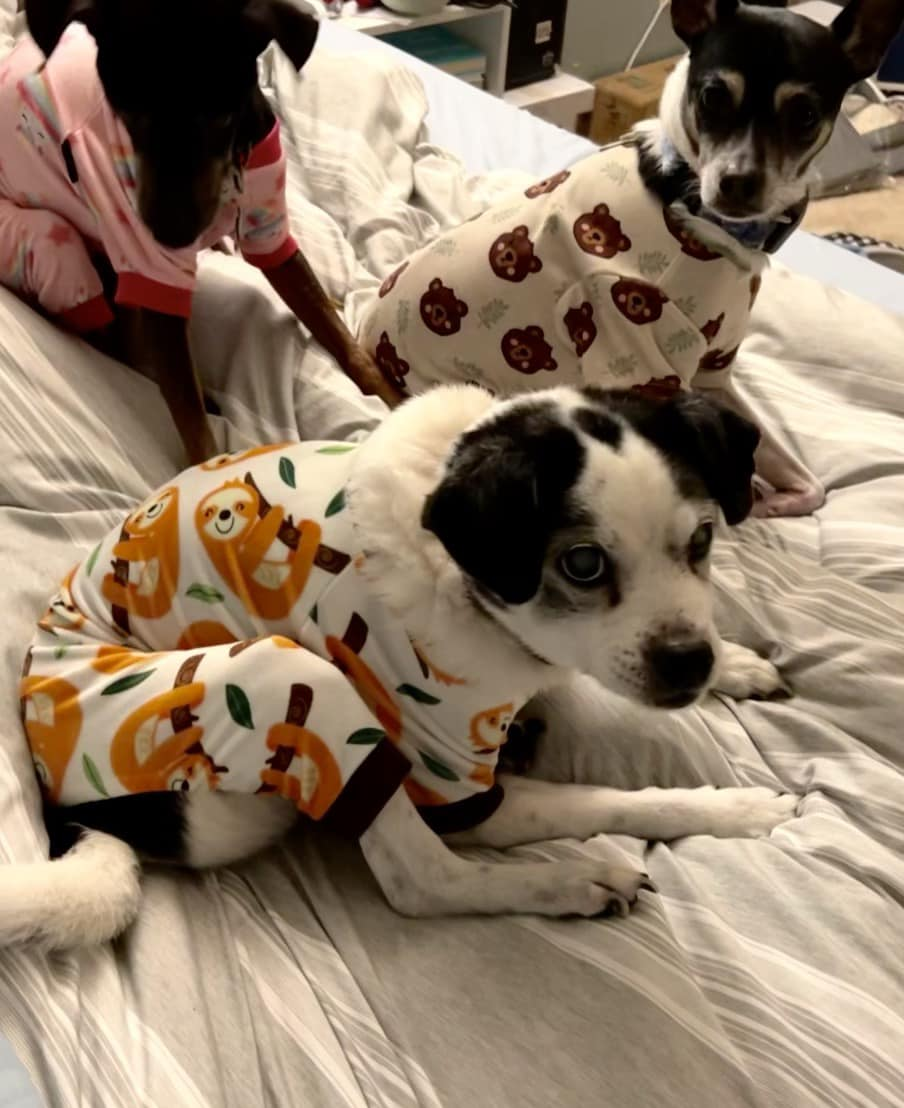
On Christmas Day we got all three of our dogs to wear pajamas.

Just Say No to Comparison

It’s the holidays, and my gift to you is that you will hear from me frequently. Just kidding.

Well, not kidding about hearing from me frequently, but kidding about it being a gift. Hopefully you have higher expectations for gifts this year.

But I am here. And I wish I could do more for those of you who read my blog regularly. I appreciate you, and you deserve the best possible holiday season. Maybe you don’t know how to make that happen. Maybe you are flying by the seat of your pants. But I am here and I am rooting you on.

Because the holidays and dementia. It’s a lot.

The holidays are hard. They can be joyful, peaceful, fulfilling, as well. They can be more than one thing.

They can be sad and rewarding. They can be difficult and joyous. They can be depressive and happy. They can be any combination of anything.

It’s not an either/or.

You get to feel whatever you feel, and it may be all over the place if you live with dementia or are a care partner. Or if you’ve lost someone recently. Or even not so recently. Or if you’re divorced or struggling with chronic illness. Or if you are struggling financially. Or if you are going through IVF.

It seems like many of us have complex situations that put us on the holiday struggle bus.

And we watch Hallmark movies (well, I don’t because the plot is the same every time and I am the least romantic person on earth) and have these expectations that our holidays will end on a happy note with a bow wrapping it all up. And then those sappy commercials with those happy harmonious families celebrating together…

Comparison is the thief of joy.

I didn’t make that up. I just Googled it, and it sounds like the quote is attributed to Teddy Roosevelt.

If you prefer, “Comparison is the death of joy” is attributed to Mark Twain. I will go with the Mark Twain version because I lived in towns on the Mississippi for the first 18-ish years of my life.

When we talk about comparison in this context, we think of the comparison between ourselves and others. The comparison between our holidays and the holidays of our neighbors. Our meager light display and the full-blown light show down the street with that giant blow-up reindeer.

Your family has been impacted by dementia. You might look at families you know and even families on TV and in the movies. Your family is different than those families. You will celebrate the holidays in a different way than other families.

When we try to mimic other families, we are often disappointed. We are not them. Even at times when we don’t want to be us, we are still us.

Sometimes the comparison that kills your joy is your comparison of past and present. The holiday season now versus the holiday season 5 years before Mom’s diagnosis. New Year’s Eve last year when Dad was around to celebrate versus now when you watch the ball drop without him.

Sigh.

Your family is not only different from other families but different from how it used to be.

It’s an obvious statement. But think about it for a sec.

Maybe the rituals you’ve always found important, like midnight mass or the all day holiday gathering with the grandkids, don’t work anymore. When you are different, you need to change.

Don’t put square pegs in round holes.

Even if your peg used to be round.

I didn’t make up the first part (although I can’t find who I should credit) but maybe I made up the second part.

Have the best possible day.

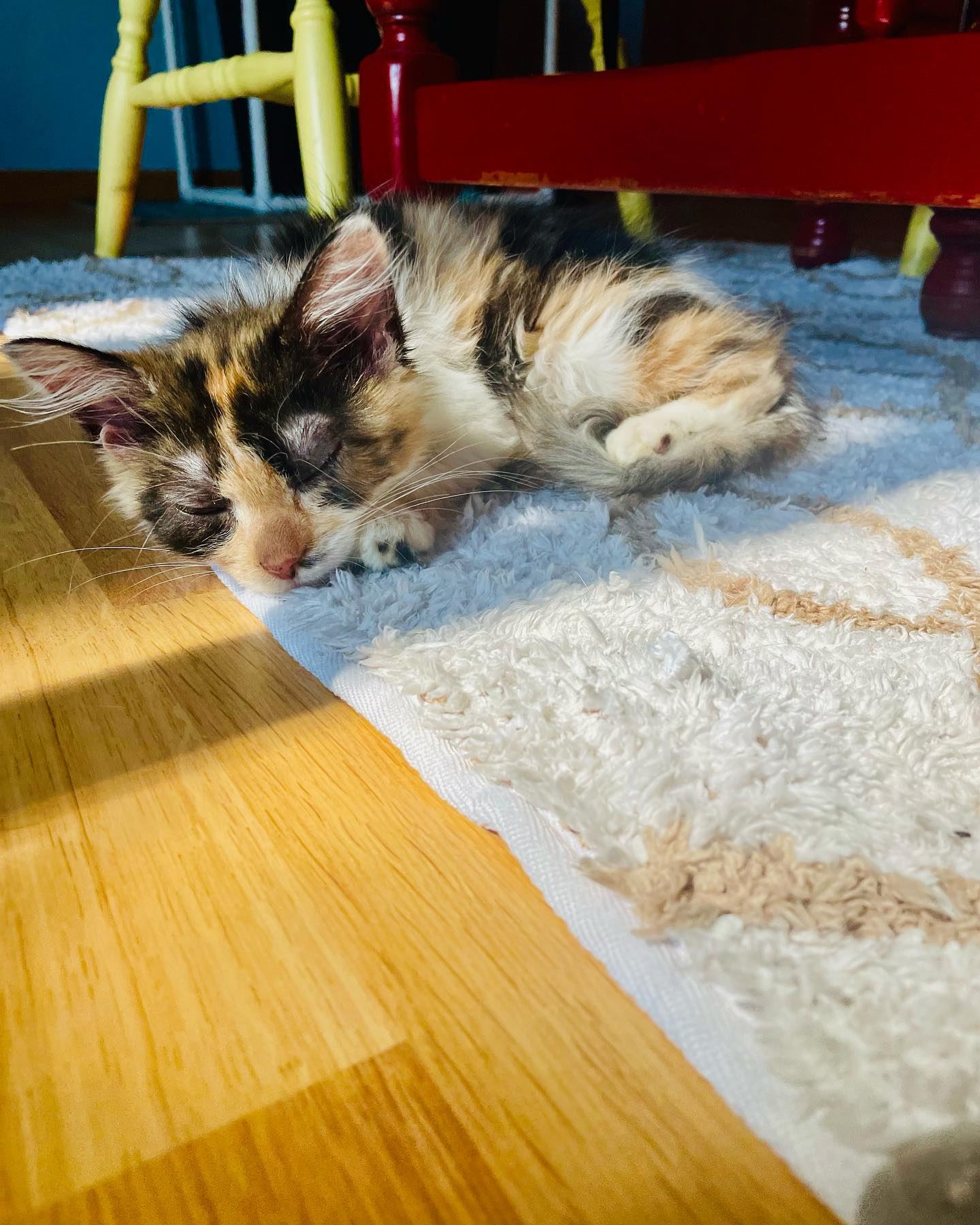
If it helps, here is a picture of our kitten, Gladys.

I am pulling out all the stops here, folks.

Calico kitten

Dementia and the Holidays: My Message to You

Happy Holidays–

I am cheating this morning, friends. I was going to write you a holiday message, but I realized I already wrote the blog post I wanted you to read back in 2016. (Can you believe I’ve written this blog that long?) So–why reinvent the wheel, right? Especially because I am not ready for the holidays. Heck, I am not even ready for today. Here’s goes…this was originally posted in December of 2016.

Oh, and also…here is a video of my dog Ernest wearing pajamas. Turn the sound up. I added music. I am who I am, folks. https://www.instagram.com/reel/C0269qoMUac/

_____________________________________________________________

I’m awake late into this Sunday night and rather than watch more reality TV or spend more money on Amazon.com, here I am with my laptop sitting in bed.

And I have a message for my families impacted by dementia. Caregivers, this is for you. The more overwhelmed, burnt out, and broken you feel, the more I want you to read this.

I wish you a happy holiday season. Or, for some of you who are really struggling, maybe happy seems a bit unrealistic. In that case, I wish you moments of happiness within a season of survival. I hope it’s not as a bad as you think it might be. Maybe it’ll be kind of like going to the dentist. The experience isn’t usually as awful as the expectation.

The holidays are a lot of fun–most of the time–for many of us–unless they aren’t. I work with many families affected by Alzheimer’s or a related dementia who look forward to Thanksgiving, to Christmas, to New Year’s…and have the most joyous time. Dementia by no means disqualifies you from having a wonderful holiday season. However, it can create some challenges.

Recently I’ve heard the following statements from family members of those with dementia:

“The kids are gonna come back to town and realize how much Mom has changed. They’re gonna tell me to put her in a home and I’m not ready.”

“My wife has dementia and I’m supposed to take her to this party. They won’t take no for an answer, but it’s gonna be a disaster.”

“I want to bring him home from the nursing home for Christmas, but I’m worried he’s gonna get aggressive when he realizes we’re taking him back.”

“I’m dreading another Christmas dinner at the assisted living where we all act like we want to be there.”

“I hate watching the grandkids around her. She gets so frustrated with them. She yells at them, and they don’t understand why.”

“Dad says totally inappropriate stuff now. I don’t know where I should take him and where I shouldn’t. And he has these angry outbursts. I am praying Christmas day is a good day for him.”

If someone in your family is impacted by dementia and you find yourself making statements like this, you’re not doing anything wrong. This is tough.

It’s not just dementia that you’re dealing with here. It’s your family dynamics. It’s friends who don’t understand. It’s people who still think dementia is about “people becoming a little bit forgetful when they get old.” You live in a world where people still don’t get it.

I don’t have any magic advice. The best I can do is to tell you that you may have to change your expectations. You may need to force yourself to find small blessings or moments of joy within what sometimes seems like a trudge through snake-filled quick sand.

The people who cheerfully work at the nursing home on Christmas day.

The neighbor who understands you are overwhelmed and shovels your driveway.

The joyful expression on your mom’s face when she sees she has just received a gift–even though she already opened that gift hour ago.

The friend who unexpectedly delivers a homemade fruitcake with a card. (And, no, it doesn’t matter if you like fruitcake.)

The families of the other residents at the nursing home who try, as hard as it is sometimes, to spread some Christmas cheer.

If you look hard enough, you’ll see the positive. I promise it’s there somewhere–for all of us. It gets buried when we go through rough times, but that’s when it’s the most important to uncover it.

And one more thing…this is important…you may have loved ones who visit from out of town and haven’t seen the changes in your family member with dementia. They may be taken aback at these changes, and they may imply or outright state that you are doing something wrong as a caregiver.

They will tell you about the internet article they read about vitamin E and dementia. They might suggest that your family member should be in a nursing home. If they are in a nursing home, they may suggest that your family member shouldn’t be in a nursing home. They may suggest your family member with dementia visit a chiropractor. They know A LOT about dementia…because they have seen a bunch of articles pop up on their Facebook feed. (Yeah, that’s sarcasm on my part. And, no, I’m not sorry.)

I don’t mince words on my blog, so here goes: SCREW THOSE PEOPLE. I’m sure they are well-meaning, but I give you permission to turn and walk away. You don’t have to get into an argument. In fact, I recommend you don’t get into an argument because you have limited time and energy, and I don’t want to see you waste even a small bit on an unproductive argument. Promise me, however, that you won’t let these people make you feel guilty. And, hey, if you give me their names, I’ll call them and tell them to zip it.

This holiday reason, be realistic. Don’t be too hard on yourself. Fake a smile but acknowledge that this might not be the holiday season you envisioned. Don’t be afraid to say no to holiday gatherings. Don’t apologize for leaving early. Stop worrying if you didn’t buy a present for everyone who is distantly related to you by blood or marriage. If it works to stay in your routine, stay in your routine. Remember that people who are critical of your caregiving just don’t get it. And when something goes horribly wrong, don’t be afraid to cry or to laugh. Either response is perfectly acceptable in my book. No judgment here, folks.

Happy holidays. You’ve got this. You’re gonna survive, and you’re gonna find a few good, or even great, things to focus on throughout the journey.
The Last Time

We care about the last time.

The last time your kid walks home from elementary school. He’s moving on to junior high.

The last time you walk out of the job you’ve had for 20 years. You’re going back to college.

The last time you have chemo. You ring a bell and learn you are in remission.

Sometimes we know it’s the last time. Sometimes we know it’s the last time and we are looking forward to a promising first time. In some cases, this is bittersweet.

Sometimes we don’t know it’s the last time. Sometimes the last time doesn’t lead to a promising first time.

The last time your dad with Alzheimer’s eats a meal without assistance.

The last time your loved one with Lewy-Body goes for her daily walk around the neighborhood.

The last time Grandpa is able to travel for three hours to see his grandkids.

A friend of mine had a last time a few months back. The last time her dad called her by her name.

She visited him at the nursing home. He was having what she considered to be a good day. He was more cognitively aware than he had been in a while, and he seemed to be entertaining himself with bad jokes.

More than a few times, he looked at his daughter and said her name intensely. He would get her attention and she’d look at him. But then he had nothing to say. My friend found that to be odd, but didn’t think much of it.

She went on vacation. During that week, he likely had a small stroke. When she went to visit him, he was struggling with speech and didn’t seem to recognize her. He didn’t call her by her name.

That was months ago. She now recognizes that the day her dad said her name several times in such a powerful way was the last time he would call her by name. She wonders if somehow he knew he’d lose the ability to call her by name in the next few days, and he wanted to call her by her name as much as possible.

You usually don’t know it’s the last time when it comes to dementia.

Often times people are telling a story and will stop and say something like, “I guess that was Dad’s last plane ride,” or “I think that was the last time Grandpa was able to go to one of the grandkid’s games.”

We usually think there’s going to be another time. Another vacation. Another basketball game. And at some point, there’s not.

I read something recently that has stuck with me:

Everything ends and that’s okay.

I’ve thought about this in terms of my capability to run a marathon (too many back surgeries), friendships, my favorite vacuum that bit the dust (is that a pun?), and life in general.

I don’t know if I feel okay about life ending. But life might lose its meaning if we live forever. And the world would be crowded. We’d have to cut down all the trees to build houses. But how would we build houses (and other things) without trees?

So maybe it is okay that we die.

We think about last words and last breaths. But we also think about other types of last times.

And with dementia, there are a lot of last times.

You Need to Walk Away

I could never have put my wife in a nursing home.

Those places are horrible. I am suprised you did that.

I will always keep my mom at home with me.

And so it goes.

You make a decision. You didn’t want to make that decision. Your wife has Alzheimer’s, and she feared at some point she would no longer be able to live at home. That time has come.

You visited nursing homes. You looked at their online reviews. You talked to anyone you knew who had a family member in a nursing home.

You did the best you could.

Repeat after me: You did the best you could.

The best you could was choosing to place someone you love in an environment where they could receive care 24/7.

And then someone makes a comment. Maybe it’s subtle and maybe it’s not so subtle.

I was speaking to a group last week when a man shared that he had been shamed by someone at church when he showed up the first time without his wife. After explaining that she was in memory care, this person said, “I can’t believe you did that.”

When this man told the story, I interrupted. (Ask my husband…I interrupt a lot.) Not because I didn’t think what he was saying was important but because it made me so angry.

Let’s back up a bit.

My dad was never diagnosed with a dementia-causing condition, but he did struggle cognitively at the end of his life. More than that, he struggled with mobility. He tried to walk. He fell. Rinse and repeat.

It was never a real option to have him live with us. I never sat down and talked to my husband about it. I never made a pro/con list. But there were times when it was a fleeting thought.

Then I remembered that there was no way we could keep him from falling. And we had stairs. Oh, and the recurrent C-diff….if you know you know.

For the last 6 months of his life, he was in a nursing home on and off.

Perhaps that’s why I interrupted this guy.

When people shame you for choosing a nursing home, it’s not acceptable. Perhaps they realize it’s hurtful, or maybe they don’t. But we need to stop.

There are enough messages out there telling care partners they are doing it wrong. You don’t need a guy at church throwing in another message.

You need more supportive people in your life. You need better friends.

You need to walk away when someone makes a comment like that.

The (Your) Important Thing

Do the important thing first.

What is the important thing? That’s for you to decide.

We all have limited energy. People living with dementia have energy that is even more compromised. They get tired–physically and mentally–quickly. And tasks that many of us find simple and mindless can be exhausting to someone living with dementia.

When the dementia brain is depleted, it needs rest. There’s no way around it. You can’t convince the individual to try harder. It isn’t a matter of laziness. They aren’t being belligerent. When the mind is too tired to continue, it must rest.

Although our energy may be significantly greater than someone with dementia, those of us without dementia still have limited capacity.

One day last week it was important to me that I finish a technical report. I had procrastinated but it was something I’d figured would only take a few hours. It was on the top of my list.

That morning, I got an email asking me for advice on a dementia situation and two phone calls about a student issue. There were not urgent matters, but I took a few moments and quickly answered the email. Then I returned one of the phone calls. By the time the phone call was over, I had a response to my email asking for more specific information. I responded to that email. As I was typing, I got an email about the student situation.

After I responded to that, I realized I had forgotten a detail that I should have added when I was on the phone, so I called my colleague back. She had just talked to a university administrator about the situation, and she filled me in on that conversation. And so it went.

I had intended to start the technical report at 8:45am. By the time I had come to a stopping point in those communications, it was 12:30. I should have had the technical report done. But I hadn’t even started.

More than that, I had lost my momentum. I was ready to dive in that morning. Four hours later, it was the last thing I wanted to do. All the emails and phone calls had cost me a significantly amount of energy.

I thought back to the moment I realized I had received the original email and noticed I had voice messages. Could I have processed the content of the communication and decided it was less important that the technical report? Yep. Would those inquiries still be there when I finished the report? Probably—but if someone else had solve the problems in the meantime, all the better.

I didn’t do the important thing first. I didn’t do it when I was sharpest and most energetic. When I finally got around to it, I didn’t have much left to contribute.

If a person has dementia and they love wrapping holiday gifts, wrapping is the important thing. Do it first. If they are too tired to go Christmas shopping or put up the tree later, that’s okay. They got to wrap gifts.

If visiting the grandkids is the important thing, do it first. Structure the day so that the person living with dementia has the most energy during that visit. If they are too tired later in the day to help clean the house, so be it.

Sometimes the most important thing is the fun thing. Maybe it’s a walk in the woods with a friend. Or going out for coffee with a spouse. Perhaps it’s watching a favorite TV show. If it’s the important thing, do it first.

Sometimes the important thing isn’t a fun thing. A doctor’s appointment. A long car ride. Sometimes it’s something hard and energy-consuming that must be done. You do it first, and set the individual up for success, while they still have the capacity to do it with the least stress possible.

Sometimes the important thing is related to self-care. Maybe it’s eating a healthy breakfast. Doing a 10-minute yoga video. Petting a dog. It’s possible that your important thing yesterday was a spin class and today it’s eating a burrito from your favorite Mexican restaurant.

Whether you are a person living with dementia or a care partner (or none of the above), the key is understanding that the world can’t dictate what is important to you. Maybe the important thing is sitting on the couch drinking coffee. Maybe it’s stopping to get a donut on the way to work even though it makes you late. Maybe it’s watching college basketball on TV, playing pickleball, building a castle in a sandbox, or looking out the window doing nothing. Yes, maybe doing nothing is the important thing. No one else has to understand why your important thing is your important thing.

I am going to bed. Because right now, sleep is my important thing.

The Bad Husband and the Failing System

Your loved one has dementia.

You know you should be patient. You know it’s not their fault.

But sometimes you aren’t that nice. You aren’t patient. You aren’t loving.

And then it sets in. Guilt. Shame. Regret.

Recently a gentleman visited our Dementia Simulation House. After doing the simulation, he sat in our living room. My students and I sat on the loveseat and couch, prepared to do our standard debriefing after the simulation.

It became obvious that he didn’t need our standard debriefing.

“I am just horrible,” he said. “I am mean and horrible.”

He told us he wasn’t always kind to his wife when she was repetitive or confused. He said that he had always tried to be patient, but doing the simulation really affected him—and made him realize that he was, in his word, a “bad husband.”

I had met the guy 20 minutes before, but I doubted he was a bad husband. Bad husbands usually don’t drive across the state on a Sunday to learn more about how to support their wives with dementia.

However, he was a husband who needed help. He needed support. He needed respite. He needed sleep. He needed exercise and a better diet. He needed a friend.

He had given everything he had to being his wife’s caregiver.

When he gave everything he had, he had nothing left to be the kind, caring, and patient husband he wanted to be.

I didn’t know this guy well enough to know what he needed. Someone from his church to stay with his wife a few times a week? Home health care? A counselor well-versed in caregiver? A support group? A meal delivery service? A house cleaner? More financial resources?

He felt like he was failing his wife. But we (meaning the field of health and social services) were failing him. We were failing to connect with him and talk about resources. We were failing in helping him make a plan so that home care was sustainable. We were failing in so many ways to help a good husband who was struggling.

We do a ridiculously poor job of connecting with caregivers and those living with dementia at diagnosis and early in the disease process. The medical profession offers a diagnosis but little to no information on how to actually live with dementia. (Trust me when I say—-my team and I are working on this, but it’s an uphill battle.)

It’s funny how this works, but when we provide more support to caregivers, they are more patient and resourceful caregivers. When we provide support to caregivers of those individuals with dementia living at home, those individuals stay in the home longer.

Caregivers, you are human beings. I spend a lot of my day talking to people about being more empathetic to those with dementia, but I am not grading you. And I don’t judge.

You are a human being. And dementia is a lot. Sure, I lecture on maintaining calm and patience with those with dementia, and I hesitate to say it’s “okay” to ever be unkind to those individuals. It’s not “okay,” but perhaps it is human to have those moments when you spend most of your time caregiving.

Snapping at someone who has asked you the same questions 25 times in an hour doesn’t make you a bad person. It just means you are human. And we need to knock it off with the shame and guilt. They don’t help you and they don’t help your loved one.

If that lack of patience becomes a pattern, consider it a cue that you need support. You are a good person who needs help.

Maybe you are not failing. Maybe you are being failed by a system that doesn’t acknowledge those who give care to adults, especially adults who have cognitive impairment.

New Support Groups! (Yes–we are doing a virtual group!)

Hi all!

We have a lot going on at the Dementia Simulation House this fall…including new support group opportunities! If you don’t live close to us in Cedar Falls, no worries–there is a Zoom group as well. These sessions will be facilitated by graduate students in our Counseling program.

I will be sending out information on some other programs we are offering soon!

If you’d like to learn more about our support groups, click here!