Category Archives: dementia

No Empty Shells

People living with dementia are not empty shells.

They are human beings.

Still, I hear it all the time.

They’re gone.

They’re just a shell.

They’re not in there anymore.

People say this because they’re hurting. Because the changes they see are painful and confusing. Because it’s hard to reconcile who someone used to be with who they are today.

Someone with dementia is as human as they have been for every moment of their life.

Yes, dementia changes people. It changes memory, language, personality, and behavior.

It can make someone unrecognizable in ways that feel cruel and unfair. But it does not erase who they are at their core. It doesn’t wipe away their humanity.

They feel love. They feel fear. They feel comfort.

Here’s why remembering that matters:

If we start believing that people with dementia are “gone,” we stop trying to connect. We stop talking to them like adults. We stop treating them with the dignity they deserve. And that is when the real loss happens.

People with dementia are still here. Different, yes. But absolutely still here.

And they deserve for us to see them.

Haircuts and Dementia

It’s easy to take certain things for granted — like sitting in a chair and getting a haircut.

But dementia has a way of turning ordinary moments into challenging ones.

A haircut might seem quick and easy to you or me. For someone with dementia, it can feel overwhelming or frightening..

Here are some of the hurdles I’ve seen — and that I wish more people understood:

  • Strange Surroundings: New places can be disorienting. Bright lights, mirrors everywhere, buzzing tools — a salon can feel like sensory overload.
  • Mirrors Can Be Confusing or Frightening: Seeing their own reflection might confuse someone with dementia. They might not recognize themselves and think a stranger is staring at them, leading to fear, anxiety, or anger. Mirrors can also make it hard for someone to tell how many people are actually in the space, which adds to confusion or a feeling of being crowded.
  • Noise and Smells: Blow dryers, scissors, clippers, hairspray — the sensory soup can be overwhelming for someone whose brain already feels overloaded.
  • Touching and Personal Space: Having someone touch their head, ears, or neck might feel invasive or even threatening. Especially if they don’t remember why they’re there.
  • Fear of Sharp Objects: Scissors near the face can trigger fear or suspicion. I’ve known people who thought the stylist was trying to harm them.
  • Difficulty Sitting Still: Dementia can bring restlessness. Sitting in a chair for 15 or 20 minutes can feel impossible.
  • Trouble Understanding Instructions: Simple directions like “Tilt your head forward” or “Look down” might be confusing. Or forgotten the second they’re spoken.
  • Emotional Vulnerability: A haircut can be a reminder of changes in appearance, aging, or hair loss — all sensitive topics, even more so for someone living with dementia.
  • Embarrassment or Shame: If someone fidgets, resists, or becomes upset during the haircut, they might feel embarrassed afterward — even if they can’t fully explain why.
  • Caregiver Proximity: Many salons or barbershops simply don’t have space for a caregiver to sit nearby. Being separated, even for a few minutes, can be terrifying for someone with dementia — and stressful for the caregiver, too.

That’s why it’s important for stylists to know if a client might be living with dementia. When they’re aware, they can adjust how they communicate, slow things down, explain each step, keep mirrors covered if needed, and create a calmer, safer environment. A little understanding can mean the difference between a stressful ordeal and a peaceful visit.

None of this means haircuts are impossible.

It just means they take more planning, patience, and understanding.

  • Go at a quiet time of day.
  • Explain each step gently.
  • Stick with the same stylist if you can.
  • Ask the stylist to cover mirrors if they cause distress.
  • Keep appointments short when possible.
  • Let the salon know ahead of time that you’d like to stay close if possible.
  • Offer lots of reassurance.

Above all, remember this:

A person with dementia isn’t being difficult. They’re having difficulty.

Going to a hair salon can be challenging for someone with dementia. A few small modifications can make all the difference.

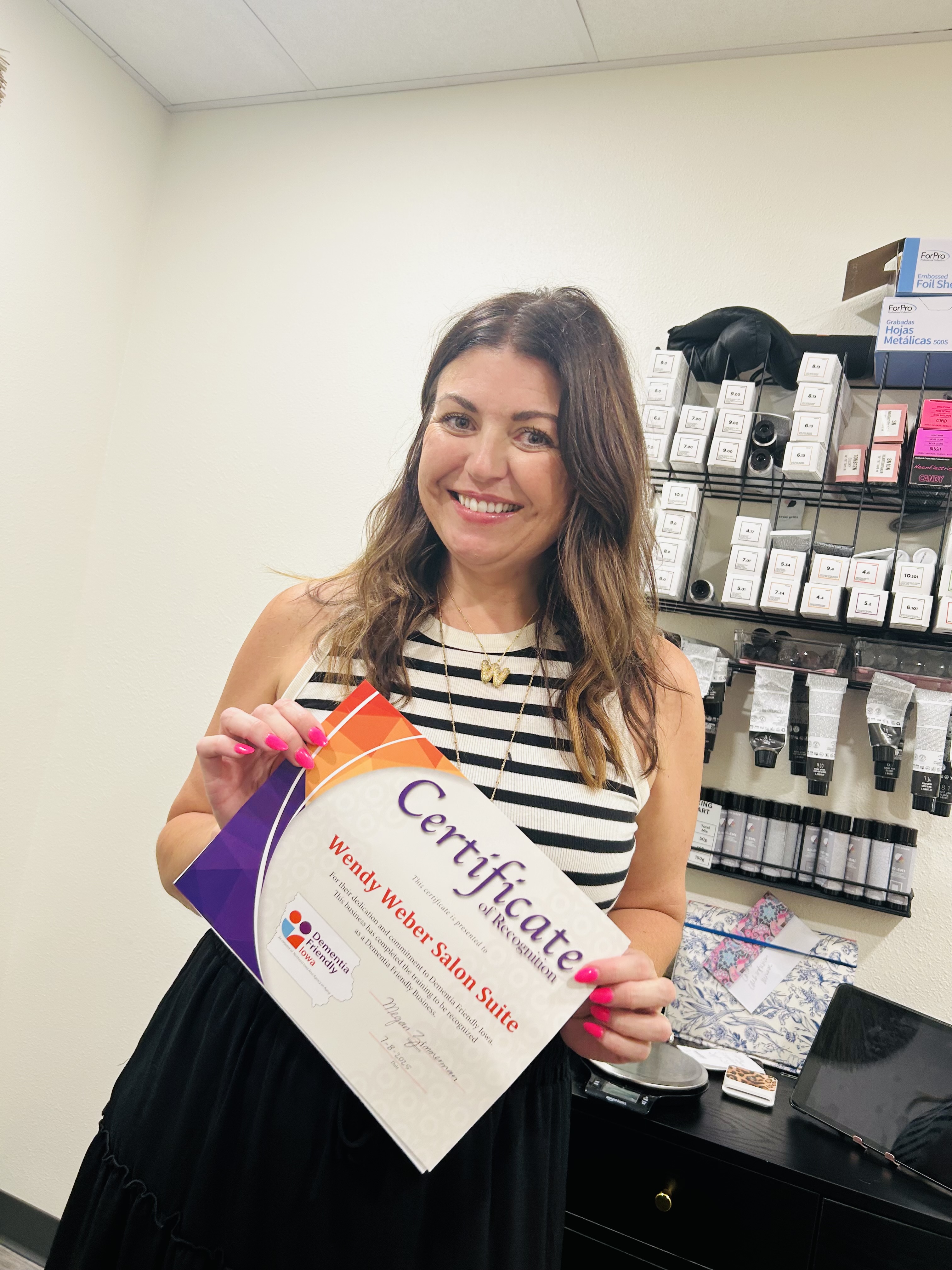
Note: If you are looking for a Dementia Friendly Hair Salon in Waterloo/Cedar Falls, Iowa, I highly recommend Wendy Weber Salon Suite. Wendy has done training with me that is above and beyond our Iowa Dementia Friendly Business and Organization Training. She has experienced dementia in her own family and is passionate about providing comfortable salon experiences to those with dementia.

More Education = Better Care!

I am happy to do dementia trainings for various sectors, but I am always honored to be asked to train staff at nursing homes and memory care communities.

I am honored because the employees I work with are generally CNAs or resident aides, and I would argue that how well they do their jobs is one of the most important factors–if not the most important factor–in quality of care.

Has it ever occurred to you in nursing homes and assisted livings that the people who are paid the least have the most direct contact with the residents?

I am continually amazed at the varying levels of dementia knowledge of employees.

I am surprised by how much people know. I am surprised how little people know.

And level of knowledge, anecdotally, doesn’t seem to be related to experience in the field.

In the state where I live, employees who work with those living with dementia have to do an online module to learn about dementia and meet the state requirement. And that’s it.

If you or a loved one are considering care, a great question to ask is, “What type of ongoing dementia education does your staff receive?

Research shows that facilities that invest in more dementia education for staff provide better care to residents. That’s not surprising, is it?

Dementia education….works.

Training programs for staff have been shown to improve staff-resident interactions, increase staff empathy for residents, and create more meaningful engagement with those living with dementia.

Dementia education increases staff knowledge, improves attitudes toward people with dementia, and boosts confidence of those providing care. They not only benefit residents but also positively impact staff by increasing job satisfaction and reducing burnout. 

If you want to look at the research studies, let me know, but the evidence is overwhelming.

Dementia education is linked to improved dementia care.

There is research about what types of education and delivery methods are most effective. When I plan a training, I go back to this research in designing something to meet the needs of the facility. I don’t deliver a cookie cutter training.

Not surprisingly, standard online modules (aka cookie cutter trainings) are not recommended as the best form of dementia education. However, I understand that facilities are challenged by staff turnover. I can’t come to your facility every week to train new employees. I get it.

Facilities are doing the best they can with the challenges and limitations that exist in the industry. Long term care is incredibly complicated.

Dietary staff, CNAs, resident aides, maintenance, and everyone else….You are doing a hard job and we need to give you the tools to succeed. And I want you to enjoy the important work that you do!

A friend of mine recently went with her father to explore an assisted living that serves those living with dementia. Her father is in the early stages of Alzheimer’s and wants to put a plan in place. (Can I just say–good for him!)

The assisted living was beautiful. A grand lobby. An enviable coffee bar for the residents. The resident rooms were spacious.

My friend, at my suggestion, asked what type of ongoing dementia education is required for staff.

She was told that they do an online module within 30 days of their start, and then yearly they must complete more online training. That’s in compliance with the state law.

My friend asked if they had opportunities for ongoing education. The response was that there was a lot of stuff out there on Tik-Tok now that shows how to “treat dementia people.”

After more conversations with other employees from the community, she was not convinced that providing excellent dementia care was a priority.

She heard some of the employees using non-dementia friendly language in chatting with her.

“Dementia person”

“Dementia sufferer”

“Senile”

People who work in facilities like this should be educated on dementia friendly language.

Despite the beauty of the building, they decided it wasn’t a fit.

While it is frustrating that some nursing home employees have a low level of knowledge about dementia, that lack of knowledge isn’t their fault. People know what we teach them. Let’s teach them.

Here’s the thing about work trainings. They can be dry and boring. I promise that I am not dry and boring. I may be weird and loud but not dry and boring.

I want employees to leave MORE excited about working with residents. I want to teach them to find the joy in their jobs and celebrate the wins. I want them to gain confidence and know that their employers in investing in them.

It’s not just about what I do, of course. There are other qualified individuals who do dementia education. (Make sure you check their qualifications and education!)

Turnover among nursing home employees in challenging for communities. If we can get people to enjoy working with those living with dementia, turnover decreases, the facility saves money, and staff provides better care.

To communities that make continuing education a priority…you deserve recognition. People should know that you are taking steps to invest in and educate your employees. Please talk about this when you market your community. It’s important.

Your commitment to education and, consequently, providing better care is admirable.

When Dementia Progresses

I recently did a Zooom consultation with a dementia caregiver. She was well-educated and it was obvious she continually sought out information to become a better caregiver.

Her husband has Alzheimer’s. She told me he had plateaued for a few years without much progression, but lately his decline had been steep.

And she wasn’t sure what to do.

After some more conversation, I realized why she had booked a consultation and what she wanted to know.

She wanted to know how to stop the decline. She wanted to know what she had done to cause the decline. She wanted to know what she was doing wrong.

But she’s not doing anything wrong.

He stayed the same. And then he declined.

She is interpreting that as what she was doing was working, and then she must have messed up or changed sometime to cause the progression.

I was interpreting it as….dementia.

I feel like I give caregivers mixed messages. I talk to them about empowerment. But I also talk to them about how they are powerless when it comes to changes that occur due to dementia.

We can change a person’s environment. We can change how we interact with that person. But we can’t stop the progression of dementia.

We didn’t cause dementia, and we can’t cure dementia.

The woman I spoke with had placed a lot of pressure on herself. She researched supplements and vitamins recommended for those with dementia. She went to online trainings for caregivers. She attended a support group to get tips on caregiving. She traveled to two different states to attend caregiving conferences.

She started cooking her husband meals based on some nutritional guidance she found online. And she knows she has to stay healthy to care for her husband, so she exercises for at least an hour a day.

Dementia had become a full time job for her.

And there wasn’t room for much more in her life.

So when he declined despite all of these efforts, all she could focus on was how she must not be doing the right things.

You can love someone and do all the right things.

No matter your efforts, dementia is progressive.

It progresses not because you did something wrong or you aren’t doing enough. Dementia progresses because it’s dementia.

We can’t beat ourselves up when someone’s dementia gets worse.

It’s not our fault.

Instead of making our goal to stop the progression of our loved one’s dementia, let’s make our goal to continue loving and caring for someone while they experience these changes.

Let’s empower ourselves to make decisions that promote quality of life for those living with dementia as their dementia progresses.

When I told this woman that dementia progresses and we can’t do anything to stop it, she said, “Wow. It’s kind of freeing to realize I don’t have the responsibility of stopping his dementia.”

And you don’t have that responsibility (or power) either.

Empowerment in Action: Culture Change through Dementia Education

Just a reminder that there are still some seats available for the Empowerment in Action conference on June 11.

I’m excited to talk about dementia and anxiety, and there will also be sessions on improv and dementia as well as how to de-escalate challenging situations. The day will end with a panel of individuals living with dementia.

This is a great opportunity for professionals as well as those who have a loved one with dementia. A student rate is available.

We are offering CEUs for Iowa nurses as well as social workers.

See below for more information as well as an opportunity to register!

Wednesday, June 11
8:30 a.m. – 2:30 p.m.
Hilton Garden Inn | 7213 Nordic Drive, Cedar Falls, Iowa

Join us for a unique opportunity to engage and share insights about how to improve quality of life for those living with dementia and their care partners. 

We will explore the following topics:

  • Dementia and Anxiety: Understand the relationship between dementia and anxiety, and explore effective strategies for minimizing anxiety among those living with dementia.
  • Dementia and De-escalation: Learn techniques to de-escalate challenging situations and foster a supportive environment for individuals living with dementia.
  • Creating Dementia-Friendly Communities: Discover how to build inclusive communities that support individuals living with dementia and their families.
  • Improv Principles in Dementia Care: Explore how the principles of improv can enhance care practices and make interacting with those living with dementia rewarding and fun!

Participants will leave the conference with:

  • An increased understanding of dementia care practices that enhance quality of life and empower individuals living with dementia and their care partners.
  • A commitment to person-centered approaches that emphasize empathy, education, and empowerment. 

Together, we can create a brighter future for individuals living with dementia and their caregivers.

You can learn more and register for the conference here: Empowerment in Action

When You Know Your Brain

I have done some virtual cognitive screenings recently. And I have one important observation.

This should not be news to anyone, but people want to be listened to.

It’s not just about administering formal tests. It’s not just about assigning numbers. It’s about listening.

I have worked with several people who have been insisting to family and friends that there is something wrong with their brain. But their loved ones make comments like, “Everyone forgets stuff,” or “I think I’m more absent-minded than you are.” In other words, their concerns are dismissed.

People think they are being reassuring when they say things like that to those who are concerned about cognition. It’s not reassuring. It’s frustrating.

How do you feel when you express a concern and you aren’t listened to?

When I do cognitive screenings, I tell people that I trust their observations of their own brain. After all, they’ve had that brain their whole life.

If they tell me something is wrong, I believe them. I don’t know if it’s dementia. Maybe it’s depression, anxiety, a physical health condition, or a sleep disorder. Perhaps it’s a result of a stressful marriage or excessive alcohol use.

But when you tell me something is wrong with your brain, I believe you.

You know how your brain works. And, sure, there are cognitive changes that occur as people get older….typical age-related change.

Maybe you forget to get gas in your car. I’m not too worried about you, but if you forget how to get gas, I am concerned.

If you call your kids by the wrong name occasionally, I don’t think much of it. But if one of your kids tells you that they are Carrie and not Kelsey–and you don’t believe them–I’m concerned.

Not every moment of forgetfulness means dementia is on the horizon, of course. But if you are insistent that your brain is significantly changing and impacting your daily function, I want to talk about it. I want to know what’s different than 2 or 5 years ago. I want to know why you are concerned.

As dementia progresses, many individuals are not reliable reporters of their own symptoms. However, I find that many people in earlier stages are quite helpful in their own diagnostic process if we only listen.

A gentleman I know went to his doctor’s office and asked for a cognitive assessment. He had been concerned about his confusion for several months, and it took a lot of mental energy for him to make this appointment.

The doctor asked him a couple of questions and then asked him to draw a clock. At the conclusion of the test, the doctor reassured him that his responses indicated he was “normal” and left the office.

And that was that. He paid his co-pay and drove him.

He was never asked for his perceptions of how his brain was changing. He was never even asked why he wanted a cognitive assessment.

And it’s too bad. Rather than leaving the doctor’s office with a sense of relief, he left feeling unimportant.

He felt like a score or a number. Not like a human being.

He scored fine on a test. Therefore, he was fine.

But he didn’t feel fine.

Finding the Joy

I do consulting work at nursing homes, assisted livings, and memory care communities. And sometimes it’s a hard crowd.

Employees don’t want someone to come in and tell them what they are doing wrong. That’s not my goal, of course, but when someone has to come in for a training on their day off, they are a little wary of me.

One of my goals is to make their jobs more fun. It’s that simple. When we have fun at work, we are more productive. Not just direct care workers….everyone.

Think about jobs you’ve had. Think about how productive you were at jobs you enjoyed versus jobs you didn’t enjoy.

At a facility, enjoying your job leads to better care and less turnover. It’s worth it to invest in finding ways to make work fun for your employees.

I would never say that it’s not challenging to work with those living with dementia. (And, I should add, that it’s challenging to live with dementia.) But I’d argue that there has to be some challenge to enjoy your job….because enjoyment at work increases when we have the satisfaction of overcoming obstacles and creating solutions. It feels good to pick up those wins.

And employees should get to celebrate those wins! That’s part of the fun, right?

One of the questions I ask senior living employees is: Within your job, what brings you joy?

Usually someone answers that getting paid brings them joy, and that’s okay. Senior living employees deserve to be paid for the hard work that they do. We know that those who are paid more generously provide better care to residents.

What else brings employees joy?

Connecting with someone.

When I help someone do something that is fun for them.

Making someone smile when they don’t smile a lot.

Helping someone achieve a goal, even if it’s like walking to the bathroom alone.

Calming someone down they were anxious.

These are all responses I have gotten. And I love these responses!

Why? Because we can work on strategies to do these things — things that are enjoyable — more!

How do we make residents smile more? I love the idea of making residents happier, but if we can work on strategies to help staff make residents smile more, it’s great for the resident and also staff. Let’s talk about how to make that happen.

How do we calm down those with dementia when they are anxious? I can teach skills to make staff more effective in alleviating anxiety. That means residents are less stressed, and it also means staff get to celebrate a win. Let’s talk about some methods of anxiety reduction.

I am not sure I’ve met anyone that enjoys every single task they do for their job. Think about jobs you’ve had. Maybe you didn’t like the paperwork, or perhaps you didn’t enjoy the public speaking you had to do. But it’s usually something, right? (And if you’ve had a job where you enjoyed absolutely everything you did, email me at dreshbaugh@gmail.com. I might consider a career change.)

I tell the college students that I teach that you are doing well in life if you like 70% of the tasks you have to do as part of your job. If 30% of your tasks are not enjoyable, you can typically tolerate that because you enjoy other tasks.

The more you enjoy those other tasks, of course, the easier it is tolerate the rest.

Let’s face it. There are parts of working in senior living that aren’t always pretty. It can be difficult and exhausting work.

How do we help staff provide better care and keep them in the field?

We focus on supporting them in finding joy in their workdays.

The Who, When, and How: Telling People You Have Dementia

Sometimes I have to check myself.

Sometimes I attempt to make things simpler than they are.

Once in a while, I am asked by someone if they should share their diagnosis of Alzheimer’s or another dementia with family, friends, co-workers, or community.

Example: A while back I chatted with a couple. The husband had been diagnosed with Alzheimer’s. They were uncertain about who they should tell. In the six months since diagnosis, they had told no one–not even their kids or closest friends.

They asked me if they should tell people.

I said yes.

I didn’t say, “Shout it from the rooftops,” but I might as well have.

When I spoke with them again recently, I asked who they had told. They looked at each other and seemed to not want to admit to me that they hadn’t told anyone.

My first thought was to tell them it was time. So I did.

It was time to tell others so others that others could support them.

But then I stopped. I realized that I sounded like I was disappointed in them. Like they were kids who had not done their homework.

I had to back up and think about all the reasons why it’s hard for people to disclose a diagnosis of Alzheimer’s or another dementia.

When I told them to tell people, I was ignoring a host of contextual factors.

So why don’t people disclose their diagnosis?

  1. Some people are just private people. And once the news gets out there, it’s out there. You can’t take it back.
  2. Individuals living with dementia may fear that disclosing their diagnosis will lead to others questioning their independence or capabilities.
  3. Each person copes with a dementia diagnosis differently. For some, keeping the diagnosis private allows them to process their feelings without external pressures or judgments. It may take some people longer to open up about the diagnosis.
  4. In some cultures or families, discussing health issues may be seen as inappropriate.
  5. A dementia diagnosis can feel like a loss of control over one’s life. Keeping the diagnosis private allows individuals to maintain some level of control over their situation.
  6. Maintaining a sense of normalcy in daily life can be crucial for individuals with dementia. They may want to continue engaging in social activities, work, or hobbies without other people reminding them that they have dementia.
  7. Many people fear that disclosing a dementia diagnosis could alter the dynamics of their relationships. They might worry that friends and family will treat them differently—either with excessive concern or a lack of confidence in their abilities.
  8. Individuals may choose to keep their diagnosis private out of a desire to protect their loved ones from emotional distress.
  9. Let’s face it. There is still a stigma that comes along with dementia. It’s a medical condition–yet many associate it with incompetence and lack of intellect.

And, for all of those reasons and others, I have to understand that I cannot tell people what they should do.

I want to encourage people to let others know when they need support. You can’t expect support when people are in the dark.

And yet, I cannot dictate the who and the when and the how.

Also, in my perfect world, when you tell others you have dementia, you get support. I know that’s not always true. Sometimes you tell people and they let you down.

I did happen to ask that couple why they had not told anyone about his dementia. Their daughter was getting married in a few months. They wanted to wait until after the wedding.

I wanted to tell them they should tell people before wedding in case they needed a little extra support during that time….. but I didn’t.

Because I don’t get to tell them what they should do.

The Value of Educating Kids About Dementia

When people think of dementia, they don’t think medical condition.

They think stupid, crazy, dependent, weird, senile, and a bunch of other negative stuff, but usually not medical condition.

I am puzzled.

Why do so many people not realize dementia is a caused by a medical condition?

I teach a college class called “Families, Alzheimer’s, and Related Dementias.” I created the course at our university and have taught it for over 10 years.

I have had several students start this course with impressive misconceptions about dementia. (If they ended the course with those same impressive misconceptions, it’s no one’s fault but my own.)

One student frequently spoke in class about how her grandma was faking dementia. Why was she convinced that her grandma was faking dementia? Because her grandma would fail at a task (like vacuuming) but then be able to do it later. If she really had dementia and forgot how to vacuum, how could she remember later? It didn’t make sense to this student, so she assumed her grandma was faking.

It took me half a semester to convince her that dementia doesn’t progress in a linear fashion. People with dementia, like other people, may forget things but remember them later.

I’ve had students who thought that dementia was a punishment for transgressions earlier in life. There was a student who insisted that you only got dementia if you didn’t believe in God–despite much evidence to the contrary. I think she was convinced this wasn’t the issue when I did a video panel of individuals with dementia and one was a minister.

Several students implied that if you were a smart person and tried hard you’d never show symptoms of dementia. If only people could “try” their way out of dementia.

I was once asked, on the first day of class, if I knew that most of the crimes in the United States were committed by people with dementia. I realized later that this student thought dementia was another term for poor judgment.

That’s only a handful of the misconceptions I’ve heard over the years.

Now I teach this course online rather than in-person. The misconceptions keep coming….only now they manifest in emails and discussion boards.

I may sound judgmental but I am not intending to come off that way. Most of my students are 18-24 years old, and what they know (and don’t know) about dementia is a reflection of what we’ve taught them.

Being a college professor makes you hyperaware of what “kids nowadays” don’t know. (I swore I’d never be that professor but here we are.)

Basic writing. Basic math. And all that….

(Me the other day: “How do you get to college and not know how to call and make a doctor’s appointment on the phone?”)

That’s not where I am going with this.

I’m talking about what people know about dementia when they come to college.

I have learned that kids don’t learn a lot about dementia and much of what they do learn is scary and plagued with negative stereotypes.

This is even true of kids who have had family members with dementia.

Our support group often tells me that members of their families are resistant to talking to the kids about dementia.

Please talk to the kids about dementia.

Please.

When we don’t talk to kids about things, kids make those things more frightening than they need to be.

And, trust me, the kids know something is going on. They always do.

If you don’t know how to talk to kids about dementia, find one of the kids’ books out there (we keep a list!) and read it to the kids.

We are willing to do Dementia Friends trainings for K-12 classrooms. Kids can even earn a certificate that they can put on the fridge.

We need to start educating about dementia the same way we educate about other health issues.

It starts with ending the stigma. It starts with stopping the whispering.

It starts with understanding, as a society, that dementia is caused by medical conditions.

It starts with knowing that a person with dementia is not stupid.

It starts with cultivating the idea that people living with dementia have worth and purpose.

It starts with raising kids in a culture that sees the value in those living with dementia.