I don’t read much fiction. Correction: I don’t read fiction at all.
I like non-fiction. I like to read about real stuff because what happens in real life is, to me, often stranger and more fascinating than fiction.
I am not picking on fiction. I know many people read fiction as an escape from the real world, and I completely respect that. It’s just never been me.
Speaking of non-fiction and raw real life…I have had more chances to connect with those supporting individuals living dementia over the last three months than ever before. And what I am learning is incredibly valuable as I attempt to create programming to support families negotiating dementia.
But, what people tell me, often seems like fiction.
I spoke with a man whose family had to buy a new couch because his dad has Alzheimer’s and couldn’t see the couch–which was a similar color to the floor and wall.
I talked to a husband whose wife is convinced he is the plumber and had come to fix the toilet. He sometimes take his tools to the bathroom and clinks them around to step into her reality. Then she writes him a check and tell him to leave.
A woman told me that her mom couldn’t stop laughing. It wasn’t that she thought something was funny. It was just that a laugh was the only sound she was able to vocalize.
A son told me that his dad couldn’t stop zipping and unzipping his jeans. He would sit in a chair all day–zip, unzip, zip, unzip. They put some sweatpants on him and he got very agitated. He didn’t seem to know what to do with his hands when there was no fly to zip. They went back to the jeans.
A granddaughter told me her grandpa would hit on her at family gatherings. He’d ask her out on dates. Strangely, she told me, her cousins seemed almost jealous that he never asked them out. It
And then there was a woman who told me that her mom had her mixed up with a character from a TV show. That TV character happened to be Meredith Grey from Grey’s Anatomy. After trying for weeks to convince her mom she was not Meredith Grey, she decided it was just easier to tell her mom that her most recent surgery went quite well.
Dementia takes us places that we would have previously considered absurd. Weird. Silly. Ridiculous.
But yet, here we are. This is what dementia is. And it amazes me when families and loved ones roll with this…they step into the role of plumbers and Meredith Grey. They dish out a few hundred dollars for new couches. They somehow roll with their grandpa asking them out on a date.
Forget fiction. This is real life, and I’m not sure how it could get more interesting, weird, fascinating, heartbreaking, tear jerking, but I would be selling humanity short if I didn’t mention love, caring, warmth, and devotion…although they sometimes show themselves in ways you wouldn’t expect. Whoever thought that acting like Meredith Grey would be that way that you were devoted to your mother with dementia? Did you ever think that pretending to be a plumber would be a way to show love to your wife?
Good morning! It’s been quite a spring semester (although it is certainly not yet spring in Iowa). In the first 10 weeks our dementia simulation house has been open, we’ve had over 230 people participate in the simulation.
It’s fun, exciting, rewarding, and lots of other positive things…in addition to being overwhelming. Although my schedule is packed and some days are a bit chaotic, I leave work feeling pretty dang good about how things are going.
And I am not doing this alone. Our team is fantastic–especially considering that until January we had no team and no house. Our soft opening was February 8th, and I am incredibly grateful for Bill, Carly, Denell, Eran, Megan, and Olivia (in no particular order–well, alphabetical order) for being a part of this crazy journey and keeping our momentum rolling.
My heart is full.
If you want to book….give us a little time. We do have four spots (probably fewer by now) left on our schedule right now but will be adding more sessions when we are able. Click here to check our schedule for openings:
Because I am who I am and I do what I do, I sometimes pause for a moment at holiday celebrations and observe how most family holidays aren’t exactly dementia-friendly. Lots for prep work and clean up. Lots of people moving around. Lots of simultaneous conversations. Lots of competing noise. Lots of choices. Lots of lots of things.
At the risk of being redundant, I want to address holiday gatherings for those living with dementia and families. I discuss this every November/December, but Easter has me thinking about it again…
I know change hard, but sometimes staying the same is harder.
It is not beneficial to be tied to holiday rituals that no longer work for your family.
Holiday gatherings can become shorter. It’s okay to have an exit plan. There can be quieter places in the home for people who need a break. Food can be simpler. A catered meal is just fine. Maybe you don’t have to invite the in-laws of your in-laws. And Aunt Jean has hosted Easter for 27 straight years. Perhaps it’s time to re-evaluate whether that’s the best space for everyone.
And (this is a hard one) maybe going to a family member’s house will be anxiety-provoking for your dad with younger-onset Alzheimer’s. You may want to consider sending a few small groups to the nursing home to visit with him in a familiar environment throughout the day.
Your mom has dementia and can no longer make her famous mashed potatoes. It’s a lot of steps and she’s exhausted by the time the gathering starts. She used to love setting up an Easter egg hunt for the kids, but she doesn’t really seem to get the concept anymore. A couple options–someone else can do it, or (and I promise it will be okay) you can NOT have an Easter egg hunt.
Sometimes clinging to rituals doesn’t set people up for success. We change as individuals. We change as families. What we used to be capable of and enjoy doing is perhaps now a stressor. So let it go.
Allowing change makes us acknowledge dementia, but there’s really no way to stop the change. It’s about whether we respond to those changes pro-actively for successful family gatherings or wait until we crash and burn and need to make an emergency plan. And the former is much less stressful for all of us.
It’s okay to re-boot the holidays.
And it’s okay that not everyone will understand.
Your wife has Alzheimer’s and she’s having a bad day, so you make a decision to skip the holiday gathering this time. You stay home and she sleeps most of the day. Your family doesn’t get it. After all, your wife seemed fine last month when they saw her out and about. They aren’t sure if you are exaggerating what’s going on with her.
YOU DON’T HAVE TO EXPLAIN YOUR DECISION TO ANYONE.
You don’t have to waste your mental energy justifying your choice. It’s not your job to make them understand. If they want to learn more, they can reach out to you and (in a perfect world) ask if they can drop by some green bean casserole. If they judge you, keep in mind that not everyone is equipped and motivated to support you on this journey. And it may surprise you who is and is not equipped. Move on.
Family is great except when it’s not great, right?
I have gotten to spend time with quite a few family dementia caregivers recently. And I had a revelation today.
When they describe caregiving, they use words like anger, sadness, confusion, anxiety, and stress. Sometimes they also use words like joy, love, and connection.
However, the word that I hear most frequently is alone.
It’s ironic that my revelation is that a lot of people feel alone. I feel like I should have a giant social gathering and buy them all beer and pizza so they don’t feel so alone. (This isn’t really a joke…we are talking about doing something like this. The beer is on me.)
Why do caregivers feel alone?
You don’t go as many places. If you do go somewhere, you rush to get back home to your loved one. Maybe your loved one is with you and people avoid you when you’re in public.
Your friends might stop calling. Maybe they don’t know that you still want to hang out. Maybe they don’t know what to say when you’re around. Perhaps your spouse was the social butterfly, and they haven’t been able to plan anything since they’ve starting showing symptoms.
Perhaps you feel like the people in your life are sick of hearing you vent about your loved one with dementia. They can’t deal with the details, like how your husband is no longer continent or how he cries at night. You finally just stopped sharing. When you’re around people, you find it hard to focus on their conversations about their lives. And you feel like there’s a wall between you and other people.
Maybe you used to work but had to quit to be a caregiver. You’re used to eight hours a day of social interaction, but now you are lucky to have one good conversation a day with your spouse who has dementia.
I don’t know if this is a comfort to you, but I get why you feel alone. Given the circumstances, it is normal to feel alone.
But you’re not alone. I could give you some astronomical number and tell you that’s how many Americans have dementia, but I don’t think we have a clue how many people have dementia. You don’t register and get a dementia card, and so many individuals are never diagnosed. People living with dementia have caregivers who might be spouses, children, parents, siblings, friends, and neighbors. You are not alone.
And, yet, we don’t talk about this a lot. There’s still a stigma. We feel embarrassment. We feel shame. Maybe we even feel like it’s somehow our fault.
I understand that caregivers feel sadness, anger, confusion, frustration, and a whole host of negative emotions. I just wish they didn’t have to feel them alone.
Two ladies came through the dementia simulation a few weeks ago. They were in their late 60’s or maybe early 70’s, and they arrived together. I thought they might be sisters, but as it turns out they were friends.
They were wonderful guests. They asked great questions relating to why people with dementia do what they do. They inquired about how one might deal with specific dementia-related issues. From the conversation, I was certain that both of their husbands had dementia, even though they did not directly tell me this.
Toward the end of the session, I asked the women who had talked the most what kind of dementia her husband had.
She smiled gently and said, “Honey, my husband doesn’t have dementia. I don’t even have a husband.”
I apologize for my confusion. I followed up with “So does one of your loved ones have dementia?”
She responded, “Her husband has dementia. And I am her friend.”
She reached over and squeezed her friend’s shoulder.
“What a great friend you are,” I said.
The women smiled. They explained that they had grown up together in a different state and gone their separate ways after high school. When one’s friend developed dementia, her friend moved to across the state to be closer.
She had never married or had children. She was retired. She rented an apartment. It sounded like she spent a lot of her time hanging out at a memory community.
For her friend.
I’ve been thinking about friendship. I have been thinking about how grateful I am for the friendships in my life. Friendships that exist in a good times and bad times, and in times where things are both good and bad all at once. I’ve always gone for quality instead of quantity with friends, and that’s served me well.
After visiting with these ladies and thinking about how much I value my own friends, I started thinking about those who don’t have strong friendships.
What if you have a crisis in your life, and you turn around for some support, and no one is there? In my field, we talk about formal supports like the Alzheimer’s Association, meals on wheels, and counseling. But what about those informal supports, like friends and neighbors? I don’t think all the formal supports in the world can make up what having supportive friends means to a person.
I like to have application in each blog post, like an action step or a suggestion. A way of changing something to improve yourself or the world. Or even just a take-home message.
But I don’t know what to offer here except this…
Friendship is a pretty amazing gift. In this world with so many billions of people, you run into a few that you enjoy and decide to find a way to see them more. And they make you happier when you are happy. And they make you feel less alone when you’re sad.
Maybe one uproots their life to be close to you. Or maybe you just have a glass of wine once in a while. In this day and age, maybe you just send them encouraging texts every few days.
But, friendship, it’s pretty cool.
After writing this post but before publishing it, I got a text from a childhood friend. My BEST childhood friend. Her dad is struggling and she wanted to get my input on nursing home placement. I had an open Sunday, so I drove an hour to visit with her. We talked about her dad. We talked about other things. I got to spend time with her kids.
When we were six years old, we had the chicken pox at the same time. (Yeah, I am old enough that I had chicken pox.) Not only did we get to stay home from school, we got to play together all day.
Today we talked about our parents’ health issues and my chronic nerve pain and how her mom hasn’t kept up with technology. And I made a spreadsheet of potential nursing home options for her dad.
Rebecca volunteered to design a logo for our dementia simulation house–PRO BONO. I cannot say enough about how amazing she was to work with, and I totally recommend her.
From the bottom of my heart, I appreciate you “getting us!”
My dad ended up on a ventilator two weeks ago today.
Quick Q and A:
Q: Did he have COVID? A: Nope.
Q: How long was he ventilated? A: Just a couple days (fortunately).
Q: Is he okay now? A: I’m not sure I’d say okay, but he’s back home. I am still pretty concerned about what the next steps might be, and I have this feeling in my stomach when my phone rings.
He was in a hospital about 2 1/2 hours from me, and I did a few trips back and forth, staying at a hotel (thanks to free Marriott points) near the hospital for two to three days at a time.
There was a day after the ventilator was taken out that he was refusing to stay in bed (even though he was unsteady on his feet) and the hospital put a camera in his room to keep an eye on him. They would have had a “sitter” to make sure he didn’t fall, but they couldn’t find one.
When I asked how he was doing, he said, “I am being spied upon.” And he was. He was on camera when he was using the commode by his bed.
To be fair to my father, he refused to stay in bed because he urgently needed to use the commode and couldn’t wait 10 minutes for someone to answer his call light. And then he got lectured by well-meaning nurses.
As for me…I was there…but sometimes not there. I found myself keeping up with various aspects of my job by finding creative places to zoom and take what I considered to be important phone calls (although they weren’t that important–all things considered).
When my dad was in the ICU, a nurse slammed the glass door of his room shut because I apparently exceeded the accepted volume level on my zoom call. If you know me, you are probably not surprised by this. I only have one volume and it’s loud. I felt awful.
A physical therapy assistant took pity on me and introduced me to a conference room that was used mostly for storage. I did a 40 minute presentation to a Lions’ Club on Rotary there. Then next day it seemed to be occupied, so I zoomed from the NICU waiting room. I was told no one ever hangs out there. Oh, and one afternoon I was zooming while sitting on the floor of the vending machine room.
The great thing about COVID (as if there is a great thing…) is that we’ve learned to make things work when we aren’t in the ideal place to work.
When my dad was asleep, which wasn’t often, I would do anything to not talk in his room so that he could continue to sleep. When was awake, he seemed to enjoy listening to me work whether it was troubleshooting a parking issue at the dementia simulation house or answering a student question. I found that my work conversations tended to entertain him more than the Winter Olympics, although he got pretty engaged in curling.
I dropped some balls at work. I apologized to my college students for being a couple days delayed on grading their assignments. One emailed me back to tell me NOT to grade their papers until things calmed down. My students are the best. THE BEST.
I am not eliciting sympathy here. I am not unique. I am walking the same journey millions of Americans walk every single day. And I understand that I am, in many ways, privileged in how I walk this journey. I have a ridiculous amount of Marriott points. I have gracious colleagues (a million thanks to my dementia simulation house right hand, Megan) that covered for me when I was gone and were willing to adjust meeting times so that I could be at the start of the visitor COVID screening line and get into the hospital right at 9am. And, I have some knowledge of resources because of the field that I work in, although I quickly learned that my knowledge of resources isn’t that impressive when I have a father who is resistant to accepting assistance.
Balancing work and caregiving is a necessity for many. Some of us can quit our jobs when a loved one needs significant care, but the reality is that most of us cannot.
Whether it’s a loved one with cancer, Alzheimer’s, Parkinson’s, Huntington’s Disease, or schizophrenia, the world around us continues. Our jobs continue. We can’t give up our health insurance. We have to pay our mortgages. And we have responsibilities other than our loved one, even when we consider our loved one to be most important responsibility.
So we continue. We take work phone calls from the ICU and pretend everything is normal. We make plans for Monday meetings when we worry that our loved one will decline….and we won’t be able to make that Monday meeting. We have colleagues (like Eran, David, Megan, Susan) who are understanding. We have colleagues who are less understanding.
We are supposed to have these two separate lives–our work lives and our personal lives. But your work life bleeds into your personal life. And your personal life bleeds into your work life. And you realize you are on a zoom meeting sitting next to your 75 year old father who has only been breathing on his own for 18 hours–and he’s asking questions like, “Do you have insurance on the dementia simulation house? If someone gets hurt, can they sue you?”
My dad was on the ventilator last Tuesday but doing well enough to be taken off. They allowed his sedation to wear off. He was wide awake while we waited for a respiratory therapist to arrive for the process. I was trying to keep his brain busy. I showed him some pics of my pets. I mentioned that I would stay the night in town, even if we had to cancel a dementia simulation house the next day. He started waving his hands in the air. I couldn’t figure out what he was trying to tell me, so I grabbed a notebook and pen out of my backpack.
In nearly undecipherable chicken scratch, he wrote—–You need a better name.
I didn’t get it at first. Then I got it.
He was telling me we needed a new name for the dem sim house.
And we do. So as they pulled out the ventilator, I talked about naming rights…because I was out of stuff to talk about and I felt like I needed to keep talking.
My experiences are different than yours, and I know my journey with family caregiving isn’t over. In fact, it is just beginning, and I may be in for some adventures over the next few years.
But we all gotta do this.
You have to face a situation where a loved one is sick, struggling, and needs you. In the moment, you’re in a crisis and life seems a bit surreal. But you call work or check in with a colleague. You send an email and let your coworkers know what’s happening. If you’re as lucky as I am, your coworkers are also your friends. They ask what they can do to help and what you need.
You answer a quick work call here and there. There are big, seemingly important things you have to do but once you are doing them you realize you don’t remember what you’ve been doing the last 20 minutes. You realize Wednesday you didn’t answer an email that someone sent Monday, and you apologize, even though considering the circumstances the email seems pretty insignificant.
If you’re me, you realize your laptop charger is 2 1/2 hours away and you have to give a zoom presentation in two hours. Best Buy tells you that you can’t buy a charger because you have a Dell and you have to order a Dell charger from the company. You panic and buy a new Chromebook. You feel guilty you spent $118 because you forget your charger, but your new Chromebook is pretty sweet.
You just make it work.
I made it work.
I would have preferred to not to be in this situation, and it was exhausting…and I am about to say something you aren’t supposed to say.
I am proud of myself.
I managed to frantically juggle a million things and modified a hundred meetings and plans, but after a couple of weeks, I felt proud. I am not saying I could have keep this up forever because I probably couldn’t have kept it up another week…yet I did have a sense of pride for making it work.
If you are a blog reader who has cared for a loved one with dementia for years, please don’t think I am comparing myself to you. I am not–and this isn’t a contest. I am saying that you are amazing. I would love it if you took a deep breath and took a moment to realize that. Every day, you make it work. You get out of bed and you make it work.
You are doing it. Maybe not perfectly. Maybe not without tears. Maybe not without a few margaritas. But you are doing it.
And we continue to do it.
From the bottom of my heart, I see you. I see how you care for your loved ones and how you manage other roles and responsibilities and just life. I see you, and I appreciate you.
A university employee stopped at the dementia simulation house the other day to deliver something. He seemed to have some curiosity as to what this project is all about, and we chatted for a bit.
He told me that his dad, who has dementia, doesn’t even try to pay attention to conversations anymore.
He looks at the ceiling. He fiddles with the buttons on his shirt. He sticks his tongue out.
Every once in while, he responds. It’s typically “yes” or “no.” Sometimes he will ask a question on a topic unrelated to the conversation.
“So how are the Bears doing?'”
“Did you ever get to go fishing this weekend?”
The man told me that he wondered if it was even worth visiting his dad at the nursing home.
I talked a bit about the dementia brain, how it struggles to block out distractions, how it tires easily, how it struggles to process language and come up with an appropriate response.
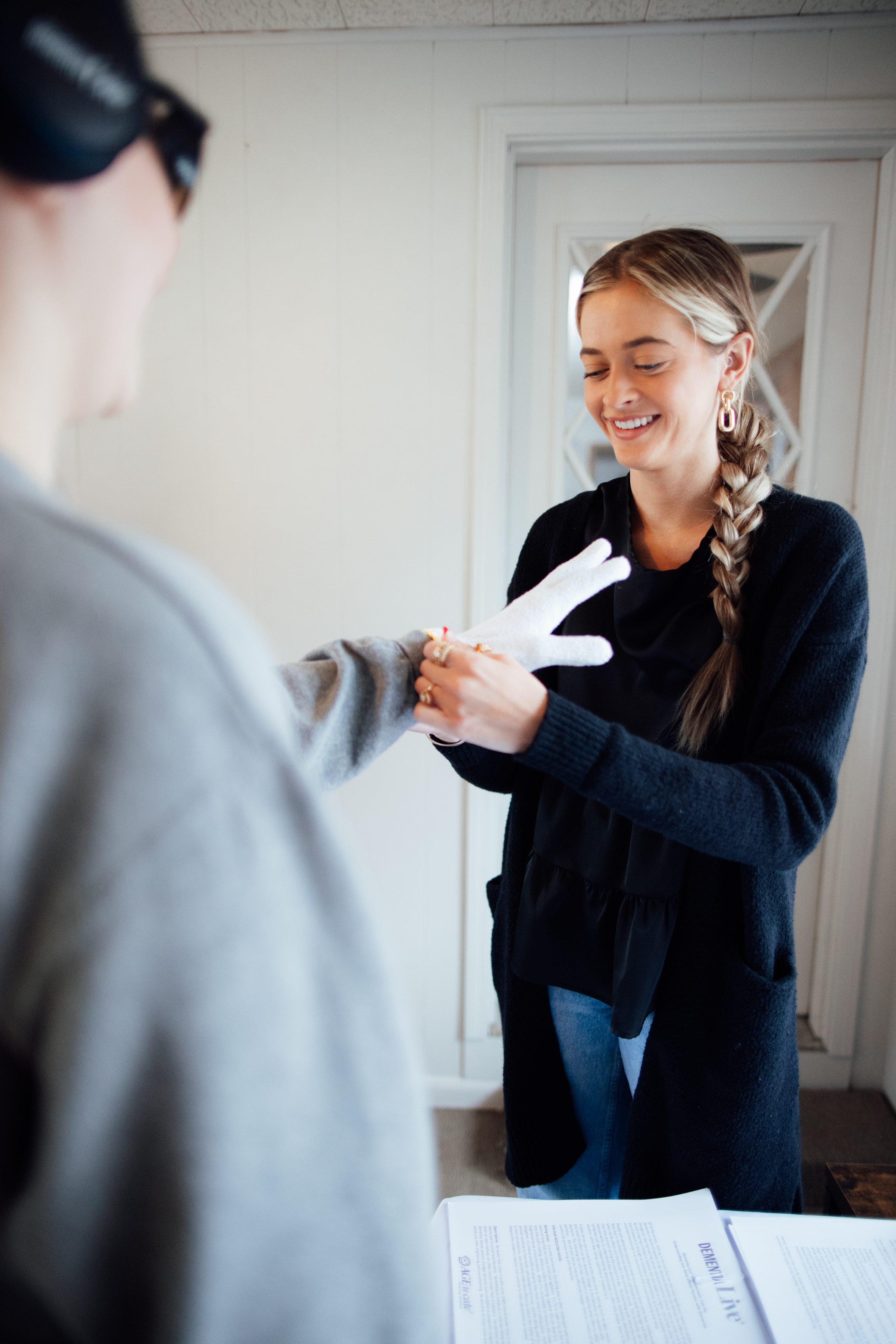
I pulled out our simulation gear to give him a quick demo of how the dementia brain interprets sensory information.
“I get it,” he said. “It’s not that there’s nothing going on in there. It’s that there’s too much going on.”
It was an Oprah-worthy a-ha moment.
He realized the environment his dad was in (a communal area at a nursing home) wasn’t ideal for a visit. He wasn’t setting his dad up for success.
There was too much going on. Another family having a conversation. A few random grandchildren running around. Another resident watching a TV in the corner.
His dad’s brain couldn’t prioritize the “important” sights and sounds. He became overloaded with info his brain struggled to process, and he shut down.
After I visited with this man for a few minutes, I realized he really did get.
We talked about a new plan for visits.
Maybe 1 or 2 people should visit at a time, rather than 5 or 6.
Perhaps it’s okay if visits are shorter because the dementia brain tires easily.
It might be a good idea to just sit quietly for a while. Not every moment has to be filled with conversation.
If your dad wants to talking fishing, you talk fishing. It doesn’t matter if it’s football season or not, talk about the Bears.
He left seemingly more positive about future visits with his dad.
You can’t cure dementia, but you can try to set people up for success.
Some of you contacted me after yesterday’s post to see what we needed at the Dementia Simulation House and suggested I make an Amazon wishlist…so I did:

 When Dementia Knocks
You must be logged in to post a comment.