All posts by Elaine M. Eshbaugh, PhD

Unknown's avatar

About Elaine M. Eshbaugh, PhD

Professor of Family Services & Gerontology at the University of Northern Iowa; Dementia Simulation House Director; Dementia Consultant to Businesses, Organizations, and Families; Spouse; Dog/cat mom; Indoor cycling instructor; Nap enthusiast http://www.uni.edu/csbs/sahs/gerontology/faculty-directory/elaine-m-eshbaugh-henninger

Oh, Father’s Day

Oh, Father’s Day.

Happy Father’s Day to those of you who celebrate. And my heart is with you if yesterday was bittersweet.

This is a Father’s Day post for those of you who didn’t have a lovely brunch with your father at a nice winery yesterday. This is a post for those of you who might have cried a little yesterday. Or maybe wanted to stay in bed all day and watch Netflix.

My dad has been gone about a year. He was the best dad he could be. He had schizophrenia, and life wasn’t kind to him. His mental illness made it difficult for me to have relationship with him. There were times he disappeared. Extended periods when I didn’t know if he was dead or alive.

And, yet, he was funny. Really funny. And really smart. He had two master’s degrees and a promising career as a chemical engineer (until he had to go on disability).

There are times my father was cruel to me, but there was also no one who was prouder of me. Mental illness is brutal and confusing. In the end, I found peace in thinking about how we had a strange but perfectly imperfect relationship. It ended with me being his person in the months leading up to his death.

My friend, Rich, recently invited me to speak at a state convention of the Lions. He didn’t know what an incredible gift he gave me.

When I arrived, a woman rushed to me and asked if I was Dr. Eshbaugh. When I said I was, she said that she knew my dad. She said she worked with him when she was at Monsanto.

And the next thing she said to me stopped me in my tracks. She said, “And he was brilliant.”

I am sure there must have been other times when people have approached me and said they knew my dad. But….I can’t remember any of them…..and I certainly couldn’t remember another time someone approached me and said something positive about him. She remembered something other than his mental illness.

I used to wish I had a different dad. Being his daughter was pretty hard a lot of the time. But now I realize I never wanted a different dad. I wanted my dad to be well. And I carry that with me.

What are you carrying?

Are you grieving your father? Maybe even grieving a father who is still living?

Does your father not remember it’s Father’s Day?

Are you resentful of the care you have to provide your father?

I saw so many social media posts yesterday about perfect dads. And they made me smile. I love happy families.

But I have to wonder…how many of us have bittersweet Father’s Days despite what we post on Facebook and Insta?

It’s a lot of pressure, really. You are supposed to key in on one individual and celebrate his role in your life. Maybe he was great but he’s gone. Maybe he’s still here, but you have a strained relationship. Maybe you never even knew him.

And if life wasn’t complicated enough, here comes dementia.

Maybe you took Dad out to eat at his favorite restaurant but he barely ate. He doesn’t get excited about much since he was diagnosed. His apathy made your time together painful.

Perhaps your Dad is in a nursing home, and you visited him there for Father’s Day. It was just sad. You left feeling guilty that it’s not possible for him to live with you.

Maybe your husband has dementia, and your adult kids aren’t reaching out on Father’s Day. They don’t know what to say to him lately, so they distance themselves.

The other day, someone told me this would be their first Father’s Day without their dad. But their dad is still alive. He lives in a facility with end stage Alzheimer’s. He hasn’t recognized her for quite some time. She cringed when she heard those words come out of her mouth.

Here’s the thing about families.

Your family wasn’t perfect before it was impacted by dementia. It’s not perfect now. Let’s acknowledge that dementia can be really hard on families.

We have this romanticized idea that families get closer when they encounter a challenging situation, like a chronic illness or a death. Research shows the opposite. Families struggle to maintain positive relationships in the face of such challenges.

You may be experiencing something you are perceiving as role reversal. Are you parenting your father? You may have increased financial strain as a result of dementia–and that’s stressing your family relationships. You had holiday rituals that you all enjoyed, but they aren’t possible anymore because of dementia.

You are not alone if your Father’s Day was bittersweet. Or maybe just bitter.

It’s okay to say you don’t like Father’s Day. Or Mother’s Day. Or Christmas. Or Thanksgiving. Or Juneteenth. Or whatever other holiday triggers you.

Maybe someday you’ll enjoy that holiday again. Maybe you won’t.

It’s okay to not be okay on those days. And on any other days.
The World’s Worst Caregiver

I met a woman recently who described herself as the world’s worst caregiver.

She told me why she’s the world’s worst caregiver.

She’s impatient.

She tells her husband “no” too much.

She gets angry easily.

She doesn’t always jump up to help when she should.

She orders pizza rather than making dinner.

She helps him take a shower every third day rather than daily.

She had some other reasons as well. I don’t remember all of them.

I remember telling her that she was going to have to give me some more extreme stuff before I would even consider her for world’s worst caregiver.

Did she have an expectation that she would always be patient? That she’d never get angry? Did she think she’d have the energy to make dinner every night? And how important is it that her husband have a shower every single day?

All I could tell her was that, while sometimes not much about caregiving is “normal,” I considered everything she told me to be pretty typical within the realm of caregiving.

Yeah, you lose your cool. Yeah, you’re angry. Sure, you shut down. You aren’t always the best version of yourself. This is real life. And it isn’t always pretty.

Be kind to yourself. You are in a hard situation. And your frustration is valid.

As for the world’s worst caregiver, her husband has Lewy-Body dementia. He doesn’t sleep much at night, so she doesn’t either. He has hallucinations and occasionally chases her with a butter knife. Her kids think she’s exaggerating his symptoms.

If she had said she never got frustrated or angry, I would have accused her of lying. And she would probably get kicked out of any support group she wanted to attend.

Why do we beat ourselves up when we are doing our best in what seems like an impossible situation? Our attacks on ourselves don’t make the situation better. In fact, they make things worse. If you want to make caregiving harder, start identifying and dwelling on all the things you are not doing well.

I was talking to a group of individuals who were caregivers to their spouses when I decided to ask them what they were doing well as caregivers. There was a long silence but I didn’t let them off the hook. Finally, a few hesitant answers.

Someone was good at covering the chores her husband used to do. Someone felt like they were doing well by always playing her husband’s favorite music at night. Another person quietly said that he was proud that he made the choice to move to a smaller and more dementia-friendly home to accommodate his wife.

This was a group that often talked about their shortcomings as caregivers. Without being asked, they never would have talked about their strengths.

Why are we like that? Why can we talk all day about our failures but not bring up our successes?

You may not be successful in every area of caregiving. But you are successful in some areas of caregiving. Turns out, caregiving is just like everything else in life. We have strengths. And we have (what I am now supposed to call) growth areas. You might know growth areas by their previous name, weaknesses.

Caregiving is also like most things in life in that you can get better at it. But you will never be a perfect caregiver.

And, if you think about it, you weren’t a perfect spouse, daughter, son, grandchild, or friend before you started caregiving. Why would you expect you’d be a perfect caregiver? Or a perfect anything, for that matter.

Be realistic and understand this is hard. Think about mistakes as data points. When you think you messed up, consider it an opportunity to learn. And move on. You don’t have the time and energy to dwell on mistakes. Rumination is inefficient.

After all, you are human. We are defined by imperfection and also by growth.

And stop being so unkind to yourself.

Do Your Thing

Thank you, friends, for your patience and understanding. I have been absent. I have excuses, of course. Blah blah blah. But maybe the excuses aren’t really for you. They are for me.

Because I owe it to myself to write more frequently.

Because I like writing.

As a small child, my career goal was “gas station man.” I liked the smell of gasoline. I still do.

As I got a bit older, I wanted to be the President of the US. I actually told the senior George Bush this when I met him at a local community college. I was in the 3rd grade, perhaps. And he leaned down toward me and pressed his forehead against mine. Yes, I rubbed foreheads with George Bush. But now I can’t think of a worse job than being President of our country.

Somewhere in there, I wanted to be a writer. As a kid, I was all about writing fiction. I created characters. Short stories. Long stories. And I enjoyed it.

I am not into writing fiction anymore. I don’t read much fiction either. I am a non-fiction girl through and through.

But I still love writing. And yet I put it last on my list of priorities. I have a lot going on, and sometimes I don’t have time to write. But I find that I do have time for other things, like spending an hour before work scrolling on Instagram.

Which brings me to my question…why don’t I make more of an effort to structure my life so I have an opportunity to do something that I find invigorating, energizing, and freeing? If I love it and it’s so beneficial to me, why don’t I do it more?

I am talking about writing this blog but other forms of writing as well. I happened to come across some writing workshops this summer at the University of Iowa. A few intrigued me. But they won’t fit into my schedule. (Could I force them to fit into my schedule? Maybe. It’s still in the back of my mind.)

Writing, for me, could help to prevent dementia. That may or may not be true for you. You see, doing something that is enjoyable and engages your brain can helpful in lowering dementia risk. Do you enjoy writing? When you write, do you lose track of time because you are so engaged? Does the rest of the world disappear when you write?

If you feel that way about writing, keep doing it. Whatever you enjoy and keeps your brain engrossed…do that. THAT is what might help to prevent or delay dementia.

For some reason, puzzles have been held up as an ultimate way to ward off dementia. And then there are those “special” puzzles that you can buy that are proven to ward off dementia. Ugh. (I hate it when people sell stuff by preying on fears of dementia.)

Puzzles are great.

If you like puzzles.

Once I met a gentleman who was concerned about his wife who was starting to show early signs of mild cognitive impairment. He read something online and made a plan. They would work on a puzzle for two hours in the morning and another hour in the afternoon. If he could keep her doing these puzzles, he was convinced her symptoms would not progress.

“Does she enjoy puzzles?” I asked.

“I don’t know,” he said. “I’ve never thought about it.”

If puzzles aren’t her thing, they aren’t doing any good.

So what is your thing? What do you do that makes the importance of the rest of the world fade away? What do you do that makes your family wonder where you’ve disappeared to? What are you doing when you can’t be bothered to answer texts and phone calls?

Is it building model airplanes? Sewing? Reading? Playing a musical instrument?

Is it bird watching? Detailing cars? Gardening? Cuddling kittens at the local animal shelter? Pickleball?

Think about what it is. And do more of it. Stop doing so much of other things and do more of this thing. Don’t feel guilty. Don’t apologize for it.

Don’t wait until you show symptoms of cognitive decline. Do it now. You like it. It makes you a better person.

I like writing and it makes me a better person. Perhaps the way it occupies my brain will lead to a reduced risk of dementia. Even if it doesn’t, it’s still a good investment of my time.

I write research articles and university reports. I write this blog. I participate in other forms of writing. I like to think that, in a small way, my childhood dream of being a writer has come true.

Elaine Eshbaugh. Spouse. Cat/dog mom. Professor. Dementia Simulation House Director. NCAA Faculty Athletics Representative. Indoor cycling instructor. Writer?

It’s way better than being President. But I would still love to pump gas for a living.

So, my friends, do your thing. And if you don’t know what your thing is, be assured you have one. Go look for it.

I Am Not That Busy

I’m back.

I can tell it’s been a while since I’ve written. WordPress asked for my password. And of course I didn’t know it. Then I had to embark on a 10 minute process that included both my phone and laptop. You know the drill.

Anyway, I’ve been busy. People in my life have noticed that I am sometimes overwhelmed and have expressed concerned. I want to sit in front of the TV with my husband and pets to watch our Netflix show, but it hasn’t happened much lately.

Also, our dog got really sick. My spouse, Bill, had to rush him over to the Vet Med Clinic at Iowa State University. He was there for over a week. It was a rough week. He’s home now, but we are keeping a close eye on him.

We organized a dementia summit at the university. I’ve had quite a few speaking engagements–most of them requiring a short drive (an hour or two). I was the chair of a search committee for an important university position.

I had a report about my productivity as a faculty member due last Monday. I had to ask for an extension, and I turned it in on Friday. I can’t ever remember asking for an extension before….ever. Not in K-12, college, grad school. Ironically, I was being too productive as a faculty member to write a report about my productivity?

It’s just one of those times in life when everything happens at once and you manage it however you can.

A few weeks ago, something changed my perspective on being busy. A woman came to do the dementia simulation. She works nights at a local assisted living.

We were killing time while waiting for other participants to arrive. I asked about what it was like to work the night shift. She said she’s done it for several years and that she likes it. It’s apparent she loves the residents and loves her job. She can’t say enough about how lucky she is to work there.

She told me that she works nights because she provides care for grandchildren during the day. I probed for more details about her schedule.

She works 10 pm-6 am, and then takes over care for grandchildren until about 4 pm. I asked her about my favorite thing in life–sleep. She said she usually could sleep a few hours in the evening, maybe 6-9 pm or so. Although I admire this woman’s work ethic, I don’t see this as healthy.

Her supervisor was there as well. She told me how wonderful and patient this woman was to the residents. And how this woman didn’t often care for own health because she was too focused on the residents and her grandchildren.

We proceeded to do the simulation. The woman was moved when she realized what it might be like to live with dementia–and what some of the residents might be experiencing. And she cried.

Working all night to care for residents at an assisted living and caring for children all day.

Having a positive attitude and valuing her job.

Wanting to learn more about how to support residents with dementia.

Many times we talk about the low standard of care in assisted livings and nursing homes. And often we do find that employees are apathetic and make mistakes. I am not making excuses for that. There are some really bad nursing homes and terrible employees.

My father was in three different nursing homes before he died. One of the three was absolutely awful. Their lack of care contributed to the series of events that caused his death. I wanted to call the state. The place should be shut down. However, I saw the people who called this place home and didn’t know where they’d go.

(Side bar: When he was transferred to a different facility, I needed a refund because we had paid for 30 days at this place and he only stayed ten. It took me 7 months and a threat of calling my lawyer to get the money back. By the way, you don’t actually have to have a lawyer to threaten to call your lawyer.)

Yet, some of the best people I know work in facilities. They are kind, loving, and skillful. They do the best they can when the facility is understaffed. And they have things going on in their lives as well.

Thinking about this woman made me remember that the people residents depend on for care are facing other challenges. Maybe we don’t know what those challenges are, but they have personal and family crises, divorces, health issues, financial problems, all of it. And many (but not all) of them show up to work and push that aside to provide care.

There is a time to complain about staff and demand better. And there’s also a time to give people some grace.

Yes, I am busy. But I am not that busy.

It Goes On

Her husband had Alzheimer’s, so she became a caregiver. She never wanted to be a caregiver. It’s not like she filled out an application for this job. It’s just what you do when your partner has dementia.

She described it as a roller coaster of a journey, and she resented the trip. There were moments of joy. There was a lot of laughter. But overall she felt cheated. Cheated out of the trips she and her husband planned for after retirement. Cheated out of how she thought she and her husband could provide childcare for the grandkids. Just cheated.

She wanted some time to herself, but she never seemed to have it. She wanted her kids to come over and stay with their dad, but they never did. She told her friends she dreamed of being able to wander around Target aimlessly on a Sunday. And sometimes all she wanted was to be able to take a hot bath without her husband walking in and needing help with something.

She wanted to sleep through the night but hadn’t in a few years. She wished she had the time and energy to put in an old fitness DVD and do a workout. Her friends invited her to go out for dinner once in a while, but they knew she’d say no. Eventually they stopped asking.

Then her husband died.

And the strangest thing happened.

She didn’t know who she was.

Every other role in her life–friend, volunteer, mother, grandma, neighbor, reader, traveler–now seemed unfamiliar and uncomfortable. And she found herself yearning to be a caregiver again.

There was a sense of relief, of course, when she had more freedom. But she also just felt empty.

She didn’t realize it at the time, but the caregiver journey–as difficult as it had been–was a journey that made her proud. She had been a great caregiver to her husband. She felt a sense of accomplishment. When she looked back, she realized that her years of caregiving for her husband were sacred and meaningful.

And yet she still felt resentful and cheated.

But she’d go back.

If she could rewind time and re-live those experiences of bathing her husband and brushing his teeth and making sure he ate, she’d do it in a heart beat. It was exhausting. And frustrating. But it also gave her this feeling of warmth and purpose. It was like she was put on this earth to care for him. And she did care for him. She fulfilled her mission.

She had a hard time finding another role that gave her that sense of purpose. Being a grandma was fun, but her grandkids were getting to the age where they didn’t need her. She started going out with her friends but felt isolated because they couldn’t really relate to what she’d been through. She did some solo travel but it just made her realize that no one really needed her.

And she’s still figuring it out. She signed up at a gym and is doing some group exercise classes. She wants to volunteer at a hospice but the training isn’t for another month. She brings snacks to her grandson’s soccer games. She’s doing some reading on finding a purpose and living a meaningful life and makes fun of herself for the stack of self-help books on her nightstand.

She knows she will get there. She’s surprised that the hardest role she’s even taken on is so hard to let go. She hated all the stuff she now misses, and it doesn’t make sense. She’s angry at herself for not finding more joy in the daily caregiving grind.

We are all constantly re-defining our role and purpose in this life. We are all searching for meaning.

But she’s really doesn’t know why she’s here now, and she has faith she will figure it out in time.

And this brings me to one of my favorite quotes:

In three words I can sum up everything about life: it goes on. –Robert Frost

Sad Relief

Hey…I’ve thinking about death lately.

I come by it honestly. I’m a gerontologist.

Even more than that, a colleague has been organizing some death cafes (Google it if you’re interested) in our community. I have been fortunate to attend a couple.

I’ve also talked to a good friend quite a bit recently. She lost her husband to dementia a year ago. And, amongst the many others feelings she may have felt when he died, she felt relief.

People don’t like to acknowledge that the death of a loved one brings relief.

But often it does. And acknowledging that it does is okay.

Let’s normalize this. Sometimes death brings relief.

That doesn’t mean it doesn’t bring sadness. Or anger. Or bitterness. Or a million other things.

It is normal if relief is hanging out with all those other feelings.

You don’t have to feel guilt for that relief. Or shame. Or embarrassment.

Relief is a completely valid response to death.

I felt relief when my dad died.

Relief for him because he was experiencing fear and distress in the days before he died.

Relief for my partner because he had been part of those sleepless nights and was debating if he should go on an upcoming work trip to Kosovo if I was still in caregiving mode.

But also—-

Relief for me because I was tired.

Relief for me because I was stressing about how I could possibly keep asking my team at work to cover everything I typically did.

I also felt sad, cheated, grateful, and loved. If I were a wine, I’d say I also had notes of bitterness and joy with a not-so-delightful aftertaste of jealousy. It was a complex flavor. But whatever.

Whatever you feel at death is okay. If someone asks how you are, it’s okay to say relieved. It’s also okay to say you’re happy, tired, pissed off, and/or hungry.

I was at a funeral once and hugged the spouse. I said “How are you?” She said thirsty. It was as valid of a response as anything.

But she apologized later for her response and told me she was devastated by her husband’s death. It’s like she couldn’t let me leave thinking that her current state was primarily thirsty.

I was thankful she had told me she was thirsty. I had walked to a convenience store across the street and bought her a Gatorade.

Devastated? I don’t know how to help. Thirsty? I got your back.

After a loved one’s death, you get to be thirsty.

Or relieved.

Reflections on the Dementia Simulation House

Hi friends,

Tomorrow is the two year anniversary of our Dementia Simulation House!

I have something different for you today. I’ve been reflecting recently on how incredibly lucky I have been in finding the right students to work with us at the Dementia Simulation House.

Our success is built on our students. They are the heart and soul of what we do, and I don’t know where we’d be without their contributions. I asked one of the graduate students on our team to write about her experience. Please read about Elsie’s experience below.

–Elaine

*****************************************************************************************

My journey at UNI’s Dementia Simulation House started November 2022 when I was searching for graduate programs in mental health counseling to apply to. I knew I wanted to work with older adults, so my number one priority was to find a school that would help me start a career in geriatric counseling.

I did some research. (The Dem Sim team knows that I love to research.) I came across the University of Northern Iowa. As a South Dakota native, I really didn’t know much about this school. However, I saw that they had a superb gerontology program, and I specifically remember bragging to my mom about how cool it was that they had this Dementia Simulation House on campus. I was amazed and thought maybe I’d have to go check it out sometime without even imagining that I’d be working there less than a year later. 

The first time I ever met our team was at Dr. Elaine Eshbaugh’s house for a little kick-off party before the semester started this fall. Right away, everyone was so welcoming. 

The people on our team really know how to make each other feel special and valuable. Most incredibly, my all-time favorite thing about the house is that there hasn’t been any drama. It blows my mind.

As a former athlete, I’ve been on a lot of teams, and I honestly thought that fighting was just a part of the deal. However, I’ve learned that there’s not much to fight about when all members of the team are so passionate about the same purpose, to make the world a better place for those living with dementia. 

It hasn’t all been roses. As anyone on our team will tell you, Elaine has a wonderful way of pushing you far beyond your comfort zone. I have a phobia of public speaking. This is a problem because, obviously, if you want to educate the community about dementia, you have to talk to them. Slowly, I’ve become more and more comfortable with this part of the job and was even able to present with Elaine at a conference this fall. 

I’ve learned so much working at the Dementia Simulation House that I can apply to my future work as a counselor. Counseling is about empathy, encouragement, and being able to walk alongside those who need a helping hand. You can’t truly acknowledge the experience of someone living with dementia if you don’t have a deep understanding of what dementia is. 

It’s impossible to uncover everything about dementia because quite honestly, not much is set in stone. Everyone experiences dementia differently. There’s no step-by-step guide on how dementia progresses or one-size-fits-all solution, and that’s why dementia is so hard. 

This variability serves as a reminder to me that to help someone living with dementia, I need to take an individualistic approach. I need to recognize that this person is still the same person they’ve always been and respect their experiences even if they look different than my own. 

This is just one of the many lessons I’ve learned from our team at the Dementia Simulation House. If you’ve never been through our simulation or have been through before but want to experience it again, please come visit us! I promise that you will walk away with more knowledge and tools that you can utilize to be a friend to those living with dementia.

Pain and Joy and Depression and Anxiety and the Party

Pain and joy can co-exist.

You’d think that intense pain means minimal joy, but that’s not always the case. We are complex beings, folks.

You can feel significant joy while feeling significant pain.

It’s not, “It was hard but it was good.”

It’s “It was hard and good.”

Life is bittersweet, right?

My dad died in May. He had schizophrenia and that made our relationship complicated. It’s Christmas, and my habit lately is to say I miss him but it’s a relief. I caught myself the other day. I miss him and it’s a relief. It’s not a contradiction.

Humans feel lots of things at once. It’s not like we process one feeling and send the next feeling to voicemail. You can’t put your feelings on silent. Sometimes they all ring at once.

You can celebrate and be sad. Every single one of us has stuff to celebrate and stuff to be sad about.

You can celebrate and be angry. You have every right to feel angry but (I mean, and) that doesn’t take away what you deserve to celebrate.

You can celebrate and bring your clinically depressed and anxious selves along for the party. I’ve done that a few times. It’s not like I don’t go to the party. I get all three of us dressed and ready. Maybe I even flat iron my hair and show up with a store-bought cake. Perhaps I don’t have a bad time.

I celebrate and I am depressed and I am on the verge of a panic attack. It can be two or more things and none of them changes the others.

Here’s to you if you are sitting around in the aftermath of a celebration trying to process. If you can’t quite put your finger on what you are feeling, that’s probably because everything you are feeling is tossed around like a giant salad. You don’t feel tomatoes or bacon or croutons–but tomatoes and bacon and croutons create something unique, and we feel uncomfortable because it’s unrecognizable to us and we don’t know if it is what we are supposed to feel.

It’s never all good and it’s never all bad. Nothing in life is all good or all bad, after all. And it’s going to change soon anyway.

And there is no “supposed to.” You aren’t supposed to feel a certain way. You’re not even supposed to do a certain thing. Let go of that. You feel like you feel and then you do what you do. And all of it is okay.

Merry. Happy.

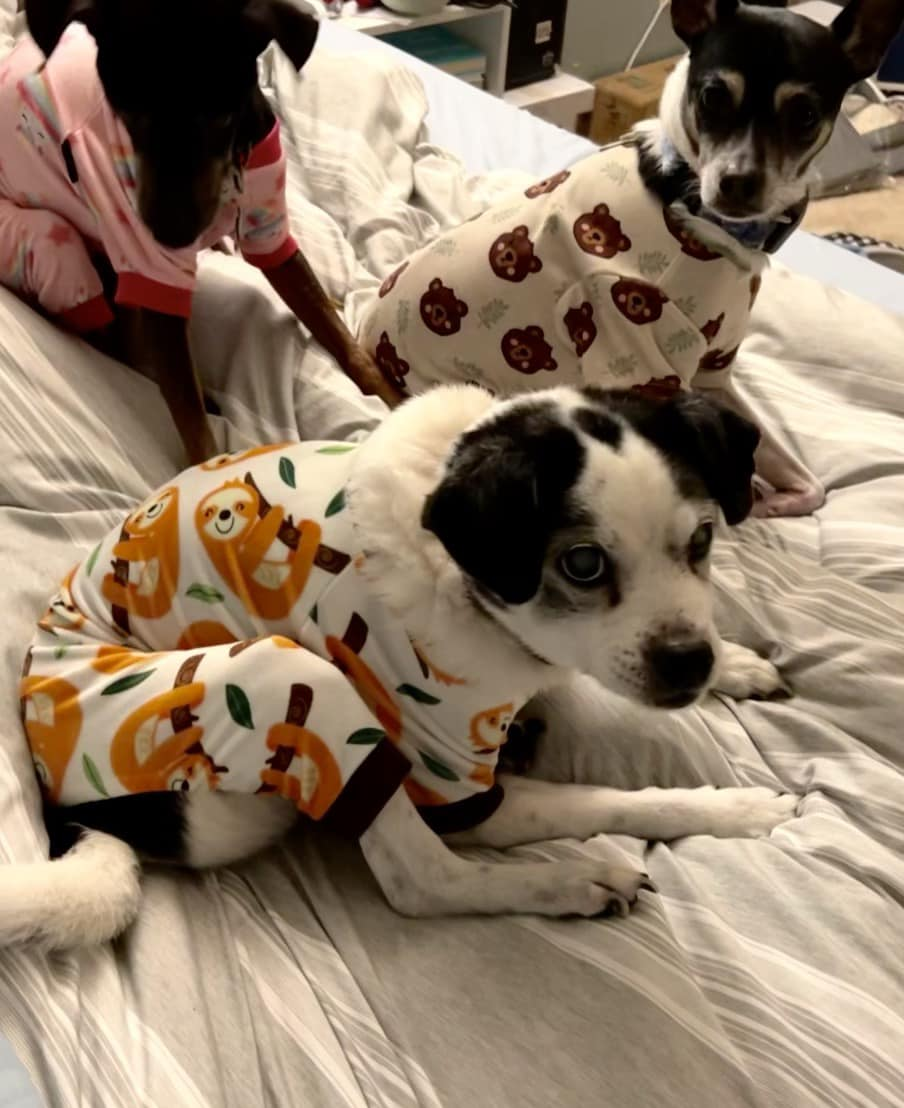
On Christmas Day we got all three of our dogs to wear pajamas.

Just Say No to Comparison

It’s the holidays, and my gift to you is that you will hear from me frequently. Just kidding.

Well, not kidding about hearing from me frequently, but kidding about it being a gift. Hopefully you have higher expectations for gifts this year.

But I am here. And I wish I could do more for those of you who read my blog regularly. I appreciate you, and you deserve the best possible holiday season. Maybe you don’t know how to make that happen. Maybe you are flying by the seat of your pants. But I am here and I am rooting you on.

Because the holidays and dementia. It’s a lot.

The holidays are hard. They can be joyful, peaceful, fulfilling, as well. They can be more than one thing.

They can be sad and rewarding. They can be difficult and joyous. They can be depressive and happy. They can be any combination of anything.

It’s not an either/or.

You get to feel whatever you feel, and it may be all over the place if you live with dementia or are a care partner. Or if you’ve lost someone recently. Or even not so recently. Or if you’re divorced or struggling with chronic illness. Or if you are struggling financially. Or if you are going through IVF.

It seems like many of us have complex situations that put us on the holiday struggle bus.

And we watch Hallmark movies (well, I don’t because the plot is the same every time and I am the least romantic person on earth) and have these expectations that our holidays will end on a happy note with a bow wrapping it all up. And then those sappy commercials with those happy harmonious families celebrating together…

Comparison is the thief of joy.

I didn’t make that up. I just Googled it, and it sounds like the quote is attributed to Teddy Roosevelt.

If you prefer, “Comparison is the death of joy” is attributed to Mark Twain. I will go with the Mark Twain version because I lived in towns on the Mississippi for the first 18-ish years of my life.

When we talk about comparison in this context, we think of the comparison between ourselves and others. The comparison between our holidays and the holidays of our neighbors. Our meager light display and the full-blown light show down the street with that giant blow-up reindeer.

Your family has been impacted by dementia. You might look at families you know and even families on TV and in the movies. Your family is different than those families. You will celebrate the holidays in a different way than other families.

When we try to mimic other families, we are often disappointed. We are not them. Even at times when we don’t want to be us, we are still us.

Sometimes the comparison that kills your joy is your comparison of past and present. The holiday season now versus the holiday season 5 years before Mom’s diagnosis. New Year’s Eve last year when Dad was around to celebrate versus now when you watch the ball drop without him.

Sigh.

Your family is not only different from other families but different from how it used to be.

It’s an obvious statement. But think about it for a sec.

Maybe the rituals you’ve always found important, like midnight mass or the all day holiday gathering with the grandkids, don’t work anymore. When you are different, you need to change.

Don’t put square pegs in round holes.

Even if your peg used to be round.

I didn’t make up the first part (although I can’t find who I should credit) but maybe I made up the second part.

Have the best possible day.

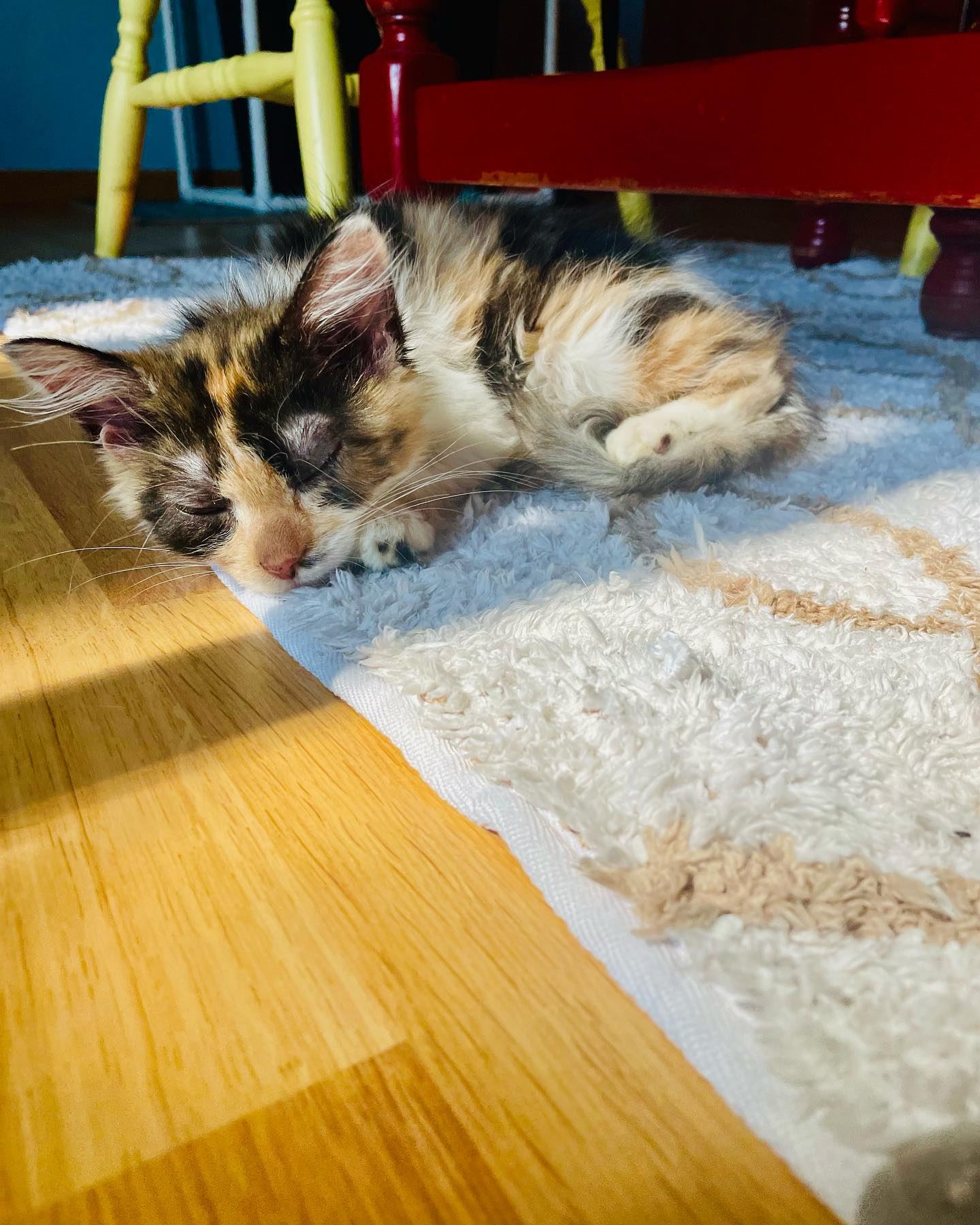
If it helps, here is a picture of our kitten, Gladys.

I am pulling out all the stops here, folks.

Calico kitten